
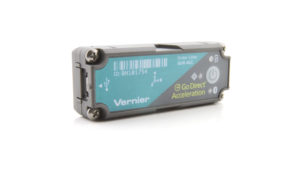
Go Direct® Acceleration Sensor (GDX-ACC)
This is our most versatile accelerometer. It has two ranges (±16 g and ±200 g), measures three axes of acceleration, and has a built in three-axis gyroscope and an altimeter. This accelerometer can be used either via USB or Bluetooth connection, with no interface necessary.
Use it with Graphical Analysis, Graphical Analysis Pro, LabQuest 2, and LabQuest 3.

Go Direct® Force and Acceleration Sensor (GDX-FOR)
This sensor includes the same three-axis ±16 g accelerometer that is used in the Go Direct Acceleration. However, a force sensor is included as well. This sensor can be used either via USB or Bluetooth connection, with no interface necessary.
Use it with Graphical Analysis, Graphical Analysis Pro, LabQuest 2, and LabQuest 3.
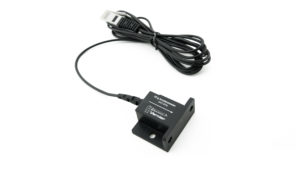
Low-g Accelerometer (LGA-BTA)
This sensor has a +/- 5 g range. If you will be doing basic classroom experiments (carts colliding, students jumping, etc.) and use calculators, or if you use an interface to connect sensors to computers, this sensor will work.
Use it with calculators, Logger Pro 3, Logger Lite, Graphical Analysis, Graphical Analysis Pro, and any model LabQuest.
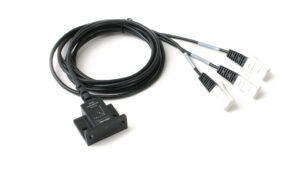
3-Axis Accelerometer (3D-BTA)
This sensor is just three of the Low-g Accelerometers in the same housing. The sensors are mounted orthogonally so that you can use it in more complicated motions such as roller coaster rides. Just calculate the square root of the sum of the squares of the 3 sensors, and you get the magnitude of the resultant acceleration. The only drawback to this model is that it requires three channels (one for each direction: x, y, and z) on the interface.
Use this sensor with calculators, Logger Pro 3, Logger Lite, Graphical Analysis, Graphical Analysis Pro, and any model LabQuest.
25-g Accelerometer (ACC-BTA)
This was our first model accelerometer. The range is +/- 25 g, which we now only recommend if you are doing fast collisions and need to see quickly changing accelerations of a large magnitude.
Use this sensor with calculators, Logger Pro 3, Logger Lite, Graphical Analysis, Graphical Analysis Pro, and any model LabQuest.
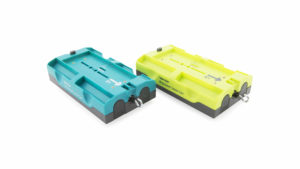
Go Direct® Sensor Cart (GDX-CART-G)
Go Direct® Sensor Cart (GDX-CART-Y)
Sensor carts also include the same three-axis, ±16g accelerometer as the Go Direct Force and Acceleration and the Go Direct Acceleration. It is in a much larger package with wheels, so we do not recommend these carts for use as accelerometers if that is all you need.
Use the carts with Graphical Analysis, Graphical Analysis Pro, LabQuest 2, and LabQuest 3.