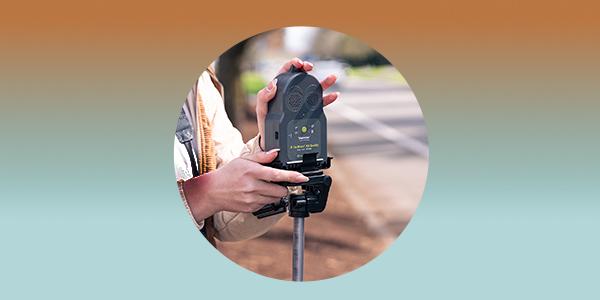
Our webinars offer innovative ways to engage students with STEM in traditional classroom or virtual environments. Our experienced educational technology specialists will walk you through experiments that students can do using our free sample data.
Wednesday, February 18, 2026
4:00–5:00 p.m. PST | 7:00–8:00 p.m EST
Are your students struggling with proportional reasoning and mathematical relationships in science? Join modeling educator Christy Jo Geraci, PhD, joined by Vernier expert Verle Walters, as she demonstrates how to use Vernier Graphical Analysis® to help students build essential mathematical thinking skills through AMTA-aligned density investigations.
Register on AMTA website. You may be asked to create an account.
Tuesday, February 24, 2026
4:00–5:00 p.m. PST | 7:00–8:00 p.m EST
Preparing students for equilibrium questions on the AP Chemistry exam this spring? Vernier chemistry experts demonstrate how to use spectroscopy to determine equilibrium constants while reinforcing Initial, Change, Equilibrium (ICE) table calculations.
Thursday, February 26, 2026
4:00–4:45 p.m. PST | 7:00–7:45 p.m EST
Interested in finding new ways to explore the mathematical beauty of light waves? Vernier physics experts Josh Ence and Fran Poodry demonstrate hands-on investigations that help students discover the wave properties of light through data collection and mathematical analysis.
Looking for easy, cross-curricular investigations to help carry you through the second half of the school year?Vernier chemistry expert Nüs Hisim along with Vernier Trendsetter Sarah Shaw, who teaches high school chemistry and physics, share a practical session focused on winter weather-inspired experiments you can use from February through spring using some of our most popular sensors.
Looking to warm up your science classroom with engaging, real-world experiments? Vernier experts Colleen McDaniel (Biology) and Dr. Melissa Hill (Chemistry) explore the science behind winter comfort foods. Explore how to measure energy in hot chocolate using calorimetry, analyze pigments in winter vegetables with spectroscopy, investigate enzyme activity in cooking, and explore pH changes in familiar recipes.
What happens when a spinning figure skater pulls in their arms? How does a playground merry-go-round change speed as students jump on or off? How do you fix a slow-ticking grandfather clock? Vernier physics experts demonstrate hands-on investigations into angular momentum conservation and pendulum motion using the Go Direct® Rotary Motion Sensor.
Looking for ways to make hands-on science easier to integrate with your curriculum—while saving time on assessment? Join former middle school science teacher and Vernier expert Kimberly Finkelman and Texas high school science teacher Rebecca Orcutt for a look at how Vernier Connections® powered by Penda can support real-world science learning in your classroom.
Give your students a hands-on introduction to the technology and scientific concepts that power today’s agriculture and natural resource careers. Vernier biology expert Dr. Sara Tallarovic explores how sensor-based investigations can help students make real-world connections while developing problem-solving, critical-thinking, and data-analysis skills essential to careers across agriculture, food, and natural resources.
Join chemistry educator Larry Dukerich and Vernier chemistry specialist Nüs Hisim as they demonstrate how the Go Direct Conductivity Probe helps students understand polyatomic ion dissolution through hands-on investigation. |
View on AMTA website. You may be asked to create an account.
Ready to turn over a new leaf in your science teaching this fall? Join Vernier experts Colleen McDaniel, Fran Poodry, and Nüs Hisim along with Vernier Trendsetter and high school educator Stacy Trosin in this special webinar presented in partnership with NSTA (National Science Teaching Association), as they demonstrate cross-curricular seasonal investigations that engage students and help solidify understanding of key concepts.
From “puking pumpkins” to decomposing leaves, you’ll explore biology, chemistry, and physics experiments that connect real-world phenomena with timely, hands‑on learning.
View on NSTA website. You may be asked to create an account.
View on Texas Instruments website. You may be asked to create an account.
When it comes to on-demand professional development for science educators, we’ve got you covered—explore our online training library today!
Interested in free professional development specific to your needs? Request a free personalized virtual training with our experts.
Subscribe to our monthly newsletter, Beyond Measure.