Sharing ideas and inspiration for engagement, inclusion, and excellence in STEM
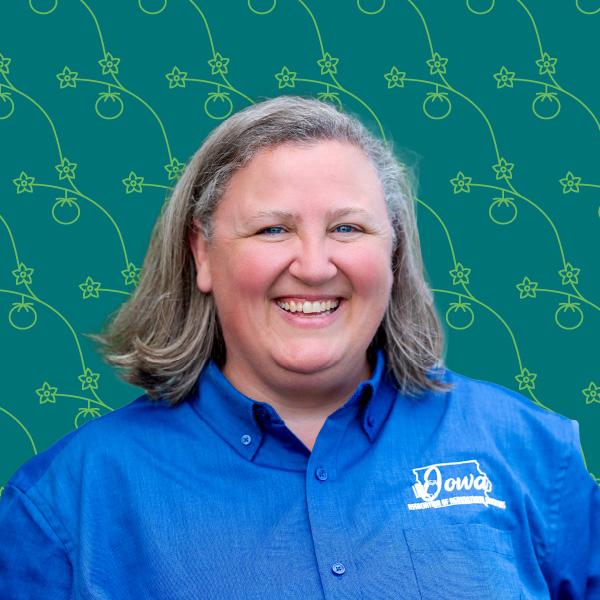
Karen Van De Walle teaches agricultural science at Denver High School and Dunkerton High School in Iowa, where she uses CASE 4 Learning curriculum and Vernier technology to support hands‑on, inquiry‑driven instruction. A recipient of the 2025 CASE Innovative Teacher Award, Van De Walle focuses on helping students build confidence, transferable skills, and a deeper understanding of science through repeated, real‑world data collection.
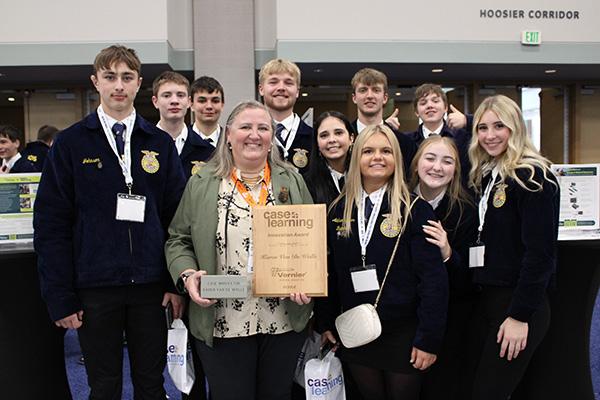
With a background in agricultural education and animal science—focused specifically on swine production—Van De Walle brings both technical expertise and practical perspective to her classrooms. At Dunkerton High School, she currently teaches veterinary science and introduction to agriculture. At Denver High School, she teaches introduction to agriculture, plant science, an eighth‑grade exploratory, and a conservation class.
Across both schools, her students arrive with very different interests and experiences. Some are interested in production agriculture, but many are not—and that’s okay.
“My goal is to help students see that agriculture is multifaceted and that the skills they learn here apply to a wide range of careers, both inside and outside of agriculture.”
Creating Structure and Purpose Through CASE
After teaching for several years, Van De Walle became a CASE instructor—something she says came into her life at the perfect time.
“I had been teaching for several years and felt like the job was harder than it needed to be—not because teaching should be easy, but because everything felt disconnected.”
CASE gave her curriculum structure.
“It’s scaffolded. Lessons build on each other. It lets kids be wrong and then show learning later, which is so important. There’s a purpose and a timeline to it, instead of just jumping from one activity to the next.”
She emphasizes that it’s still a lot of work. Labs need preparation and supplies must be ready. But the time she puts into it feels focused.
“I know my students are going to get the most out of it, and honestly, I think CASE has kept a lot of really good teachers in the classroom.”
Within that structured, inquiry‑based framework, Vernier technology fits naturally.
“Using sensors makes my students feel like scientists,” she says. “They’ll say things like, ‘Oh, I get to use a pH sensor today to test the hydroponic system,’ and I get to say, ‘Yep, you do.’”
What she appreciates most is that sensors aren’t used once and put away. Students encounter them multiple times across different classes and units. At first, some students are nervous about using the technology. By the second or third time, they’re more willing to try, and that’s when their confidence starts to grow.
Connecting Classroom Technology to Real-World and Career Applications
For Van De Walle, repeated, hands-on data collection is essential.
“I want my students to understand that technology and tools matter—no matter where they’re headed,” she explains. “Whether they’re going into production agriculture, food science, conservation, or something completely different, knowing how and when to use tools is important.”
She and her students talk frequently about how tools have specific purposes. It might be a bale moisture tester to see if hay is ready for the barn, a refractometer in food science to determine if honey is ready to harvest, or a pH sensor to test water quality.
“Those skills transfer.”
One moment that stands out involved a student who worked at a local pool and used pH paper to test water quality. When Van De Walle pointed out that they had been using pH sensors in class all year, it clicked.
“It was the same concept—just more precise and calibrated. They’re using the same type of measurement tool to test acids and bases in orange juice, to monitor hydroponic systems, and to check whether pool water is safe. That’s the kind of connection I want students to make.”
This isn’t just “school science,” she says. These are skills students can apply in multiple real-world situations and careers.
“When students can say, ‘I know how to do this,’ that confidence is going to carry far beyond my classroom.”
Building Technical Skills and Confidence Though Hands‑On Experience
In her plant science course, students build hydroponic systems and test pH and conductivity every other day to determine whether they need to adjust the system to maintain plant growth. In her intro to agriculture class, they begin with something simple: using a temperature probe to measure the warmth of their hands.
Most students instinctively know their hand temperature cannot be 200°F. That baseline understanding helps them question unrealistic data.
But in more advanced courses—especially for students who haven’t had prior exposure—those instincts aren’t always there. Some students couldn’t explain that pH ranges from 0 to 14. If they saw a reading of 14, they didn’t immediately question it—they just wrote it down.
That’s why repetition matters.
Students who have used sensors before already know how to connect them, interpret data, and troubleshoot results. Others need more guidance at first. But as they encounter the technology again and again—across different courses and contexts—they grow more confident.
Van De Walle doesn’t use sensors once and put them away. Students see them repeatedly, in multiple applications. Over time, they begin to view data collection as a normal, expected part of scientific investigation rather than something intimidating.
The result is not just stronger technical skills, but stronger collaboration. Students work in teams, divide measurement responsibilities, share data across systems, and help each other interpret results.
The more they use the tools, the more capable they become—both with the technology and with scientific reasoning.
Looking Ahead: Long‑Term Data, Long‑Term Thinking
Van De Walle is particularly excited about upcoming investigations in her water unit, during which students will test a nearby stream. She looks forward to asking students why they think certain parts of the creek freeze while others remain open—and then collecting real data to explore those answers.
She’s also preparing to install a new weather station, especially with plans for a future greenhouse. Collecting long‑term data on temperature and humidity—and analyzing how conditions change throughout the day and year—will give students even more opportunities to connect environmental data to agricultural decision‑making.
“That kind of long-term, real-world data collection is where I think hands-on ag science really shines.”
Learn more about how Vernier supports agricultural science, CASE, and other career and technical education. Questions about our sensors? Reach out to support@vernier.com, call 888‑837‑6437, or drop a question in our live chat!
Share this Article
Related Articles

Sign up for our newsletter
Stay in the loop! Beyond Measure delivers monthly updates on the latest news, ideas, and STEM resources from Vernier.