

Sharing ideas and inspiration for engagement, inclusion, and excellence in STEM
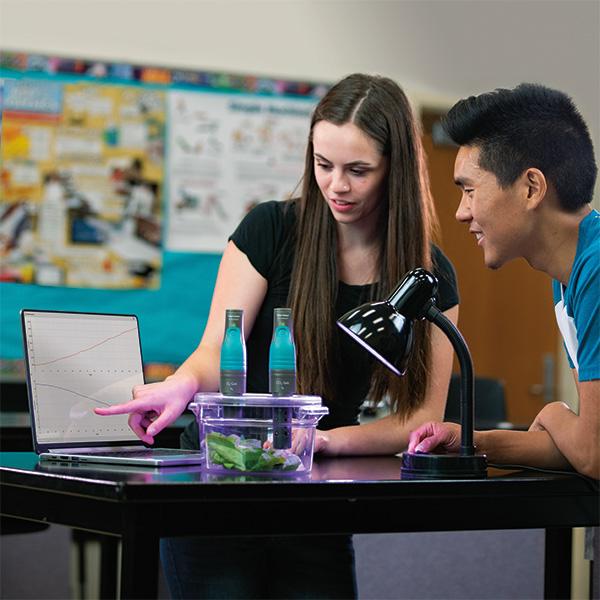
Photosynthesis and cellular respiration are essential concepts in any biology class, but because they’re abstract, they’re often tricky for students to grasp. As a former biology educator, I know how challenging it can be to help students move beyond memorizing equations to actually seeing what’s happening inside plant cells. For example, many of my students once believed that only photosynthesis happens during the day, and that cellular respiration only happens at night—they really struggled to see how the pathways are connected. Helping students visualize these invisible processes with data can illuminate some of those connections.
In this post, I’ll share three hands-on experiments that make these processes visible through real-time data collection. Each method uses Go Direct® sensors and can be adapted for different grade levels, from introductory high school biology to AP and college.
1. Measure CO2 and O2 Exchange with Fresh Leaves
Based on Experiment 31 from Biology with Vernier
Best for: Introductory and high school biology classes learning to connect photosynthesis and cellular respiration
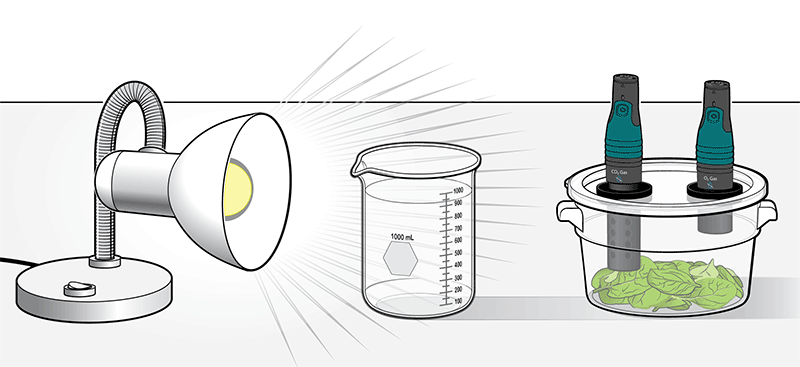
One of my favorite ways to make photosynthesis visible for students is to use the Go Direct CO₂ Gas Sensor and Go Direct O₂ Gas Sensor. In this experiment, students place fresh plant material—spinach works wonderfully, but kale, lettuce, or even maple leaves can work too—into a respiration chamber and collect data as the leaves alternate between darkness and light. The setup is pretty simple, and you can get great results in just 10–20 minutes.
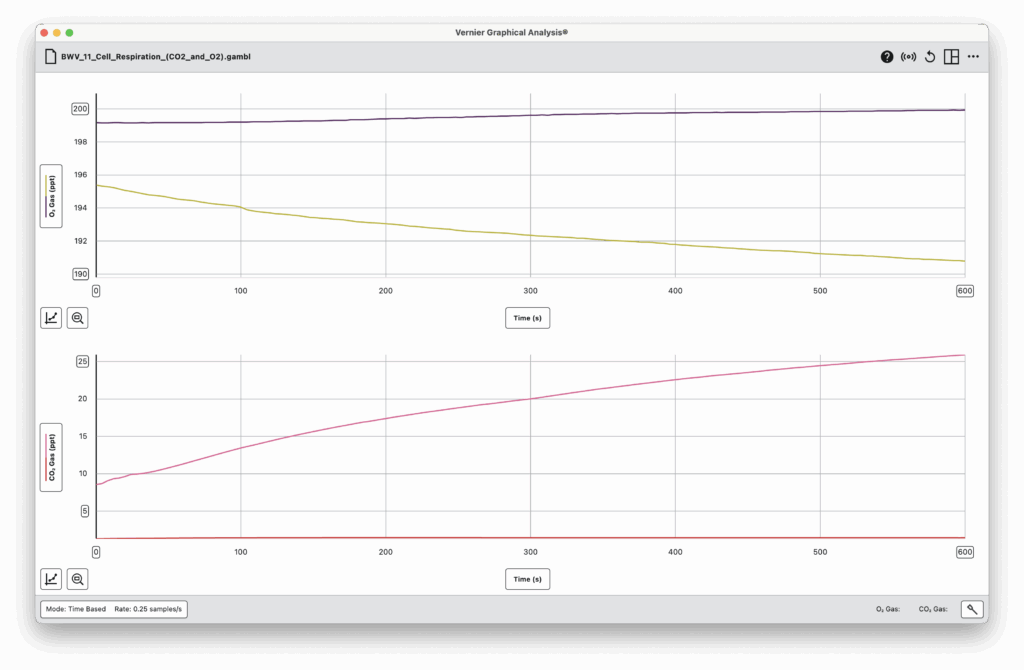
When the chamber is wrapped in foil, students observe only cellular respiration: CO₂ levels rise while O₂ levels fall. Once the foil is removed and the leaves are exposed to light, photosynthesis begins and outpaces the effect of cellular respiration: CO₂ decreases and O₂ increases. It’s helpful to remind students that plants require the energy from cellular respiration all of the time, dark or light, so that process is always happening in the background. The gas exchange from photosynthesis is just more dramatic. Watching these transitions unfold in real-time graphs helps students grasp these dynamic biochemical pathways.
Tips for Success
- Use fresh, clean, dry leaves. Wilted or wet samples can produce poor results.
- LED grow lights provide the best spectrum with minimal heating.
- Start with cellular respiration (foil-wrapped) before moving to photosynthesis.
- Use a heat sink—such as a 1 L beaker of water—between the lamp and chamber to prevent overheating and condensation, which can disrupt sensor readings.
- For shorter or introductory class periods, you can focus on CO₂ alone to simplify setup.
NGSS Connections
- HS-LS1-5: Use a model to illustrate how photosynthesis transforms light energy into stored chemical energy.
- HS-LS2-3: Construct and revise an explanation based on evidence for the cycling of matter and flow of energy in aerobic and anaerobic conditions.
2. Explore Aquatic Photosynthesis with Dissolved Oxygen
Get the Free Experiment Download
Best for: Environmental science or biology courses exploring ecosystems and water quality
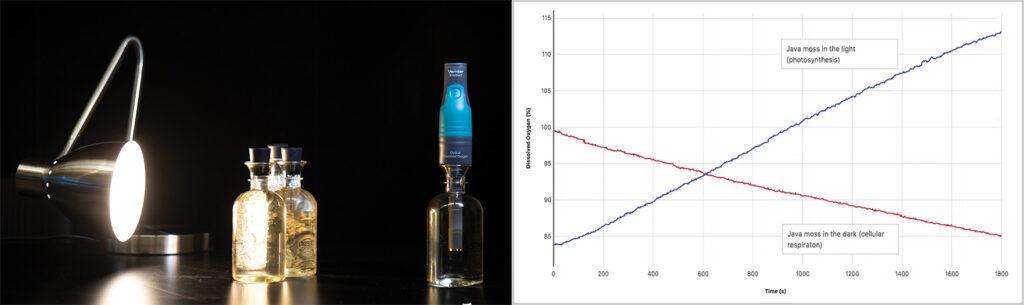
To connect photosynthesis to ecology, I often use the Go Direct Optical Dissolved Oxygen Sensor. This approach works beautifully with aquatic mosses like Java moss or Christmas moss (Vesicularia spp.)—or even simple algae cultures. Students measure dissolved oxygen in light and dark conditions to see how oxygen levels fall in darkness (cellular respiration only) and rise in light (photosynthesis plus cellular respiration).
In the classroom, this experiment always sparks great discussions about ecosystems. Students can immediately connect the dissolved oxygen data to the needs of fish, algae, and other aquatic life. It also helps them understand why oxygen levels fluctuate in ponds and aquariums.
Tips for Success
- Prepare “aged” tap water by letting it sit uncovered overnight.
- LED grow lights provide the best spectrum with minimal heating.
- Try substituting green algae cultures for moss to vary the approach.
NGSS Connections
- HS-LS1-5: Use a model to illustrate how photosynthesis transforms light energy into stored chemical energy.
- HS-LS2-5: Develop a model to illustrate the role of photosynthesis and cellular respiration in the cycling of carbon among the biosphere, atmosphere, hydrosphere, and geosphere.
3. Track Electron Flow with Chloroplasts and DPIP
Based on Experiment #7 from Biology with Vernier and Experiment #12 from Investigating Biology through Inquiry
Best for: Advanced high school or college biology courses focused on biochemistry and energy transfer
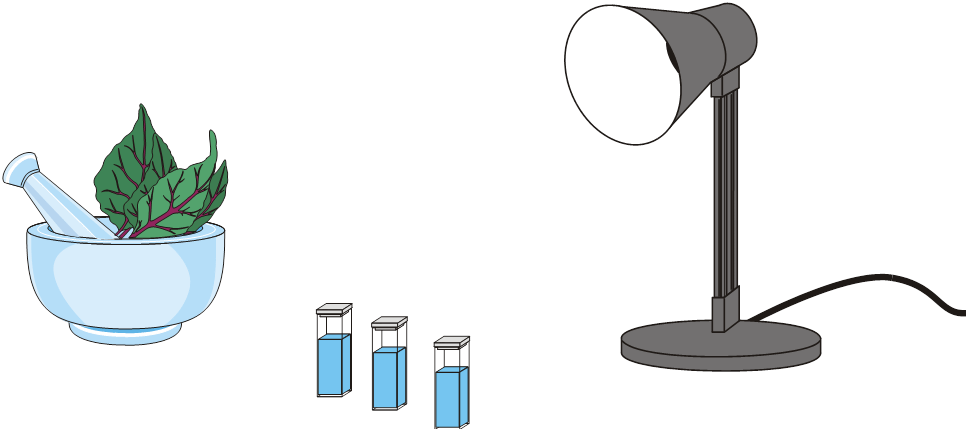
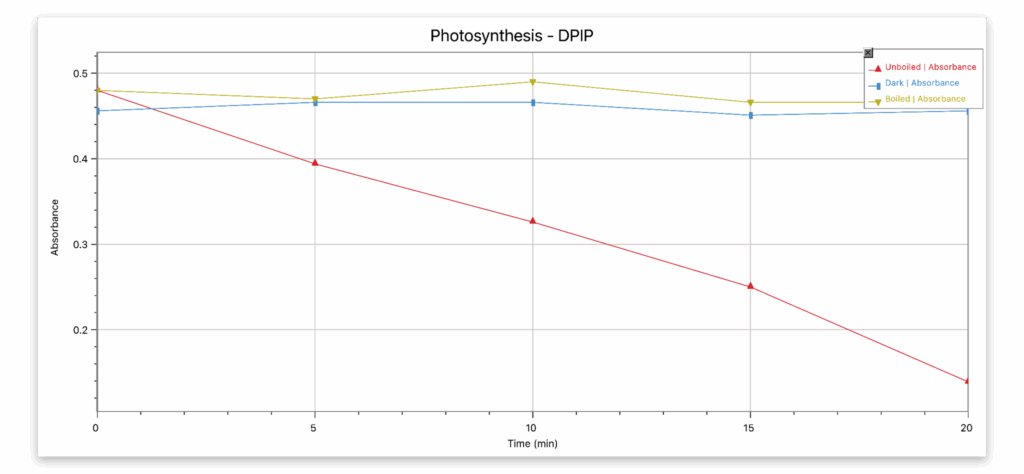
For advanced high school or college biology students, the Go Direct SpectroVis® Plus Spectrophotometer enables students to explore the light‑dependent reactions of photosynthesis at the molecular level. In this setup, isolated spinach chloroplasts are mixed with DPIP, a blue dye that becomes colorless when reduced. As photosynthesis proceeds, students observe the decrease in absorbance at specific wavelengths, indicating the movement of electrons through the light reactions and then passed to the dye molecules.
When I first ran this lab with my freshman biology students, it quickly became one of my favorite demonstrations of energy transfer. We used it while covering cellular processes in our biochemistry unit, and it was such a powerful way to show that there are actually electrons moving and transferring energy—something students could finally see and measure. Watching the DPIP solution lose its color helped them make the connection between what’s happening in the photosystems and how light energy drives electron movement through the reactions. It’s an example I came back to again and again throughout the course.
Tips for Success
- Keep chloroplast suspensions on ice to preserve activity.
- Use a water-filled flask as a heat sink to protect samples under strong light.
- Have students design their own variables to investigate for true inquiry learning.
NGSS Connections
- HS-LS1-5: Use a model to illustrate how photosynthesis transforms light energy into stored chemical energy.
- HS-LS1-7: Use a model to illustrate that cellular respiration is a chemical process whereby the bonds of food molecules and oxygen molecules are broken and the bonds in new compounds are formed, resulting in a net transfer of energy.
Looking for more?
Want to hear even more about these experiments from our biology and environmental science team? Watch the full webinar recording and download free sample experiments from Vernier, including step‑by‑step instructions and data‑collection tips.
What’s your favorite way to teach photosynthesis and respiration in your biology classroom or lab? Let us know and share with us on social! Questions? Reach out to biology@vernier.com, call 888‑837‑6437, or drop us a line in the live chat.
Share this Article
Related Articles





Sign up for our newsletter
Stay in the loop! Beyond Measure delivers monthly updates on the latest news, ideas, and STEM resources from Vernier.