
Sharing ideas and inspiration for engagement, inclusion, and excellence in STEM
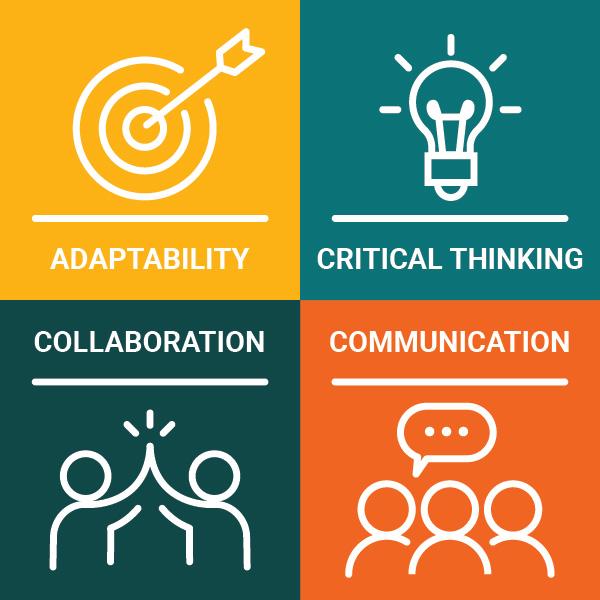
What does it actually mean to prepare students for the future? What skills do they need to succeed in tomorrow’s workforce?
These questions are deeply intertwined into the work we do here at Vernier Science Education, and it’s what brought us together with Marzano Research for a recent webinar, “Beyond the Buzzword: Making Employability Skills Central to K–12 Learning.” During the webinar, we discussed new research underscoring the importance of cultivating students’ employability skills and, importantly, heard from CTE and curriculum leaders from across the country about how they are putting this research into practice.
Below are the key takeaways for making employability skills visible, measurable, and intentional across your own schools.
1. Employability Skills Aren’t Extras
and Should Start in Pre–K
Marzano Research, in partnership with the US Department of Education’s Office of Career, Technical, and Adult Education, recently reviewed more than 22,000 resources—including labor market data, policy documents, research studies, and expert panels—to help modernize the national Employability Skills Framework. After narrowing this down to just over a thousand relevant sources, a few findings stood out.
First, there is strong consensus on what the core skills are. The research identified eight areas employers consistently prioritize:
- Adaptability & continuous learning
- Communication & collaboration
- Creativity & innovation
- Global & social awareness
- Leadership & responsibility
- Problem-solving & critical thinking
- Professionalism & self-management
- Technology & information fluency
There is also a real gap between education and workforce expectations. Employers consistently report wanting greater adaptability, more applied real-world experience, and stronger problem-solving—not just technical knowledge.
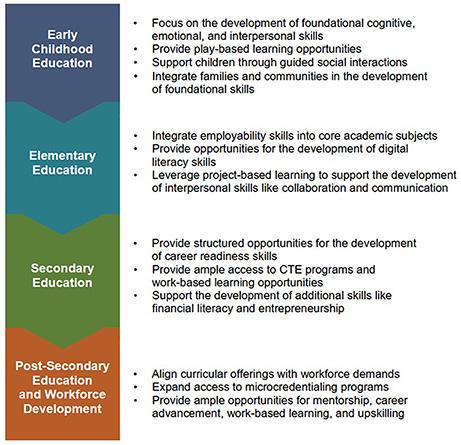
Most importantly, skill development needs to start early. Foundational habits like collaboration, self-regulation, and digital literacy can and should be introduced from elementary school onward, not saved for CTE electives in high school. In early childhood, this can be as simple as building foundational habits through play and structured interaction, including early emotional development and basic cognitive skills. By elementary school employability skills should be integrated into everyday academics: learning to collaborate, work in teams, and develop early digital literacy. By elementary school, employability skills should be integrated into everyday academics: learning to collaborate, work in teams, and develop early digital literacy. By secondary school, the focus shifts to applying those skills through CTE pathways, work-based learning, and real-world contexts that mirror what employers actually expect.
As Trudy Cherasaro of Marzano Research put it, “We can’t treat employability skills as an add‑on. They must really be intentionally developed throughout the education experience and connected to real‑world context.”
While employability skills can go by different names, such as navigational skills or workplace readiness standards, it is important to focus on putting the systems, expectations, and structures in place to teach students these skills.
2. AI Is Reshaping What Employability Skills
Look Like in Practice
The core employability skills haven’t changed dramatically—but how students need to apply them has. District leaders also discussed the evolving role of technology, especially AI, in shaping how employability skills are developed and demonstrated.
Kian Zare, college, career, and military readiness coordinator for Houston ISD in Texas, emphasized that effectively communicating with AI tools is becoming its own core skill—one that draws on the same competency as communicating with people. “I think we’re going to be applying [communication skills] to large language models a lot more than we think at the moment,” he said, describing how working effectively with an AI model requires understanding its strengths and tendencies, much like learning to work with a colleague.
Aurora Hymel, CTE coordinator at West Ada School District in Idaho, tied the rise of AI to the urgency of continuous learning as an equally important employability skill, saying, “The number of times our students are going to have to re-skill throughout their careers is going to be accelerated with all the new technology.”
Carolina Cano, assistant director of CTE for Portland Public Schools in Oregon, recommends district leaders lean into AI rather than trying to prohibit it. “We need to teach students to work with technology and accelerate the pace of change in the industry,” she said. “And we need to give students the skills to identify when something is made by AI.”
For district leaders, this means providing teachers with access to AI and the professional development needed to help them effectively teach students the responsible use of the technology.
3. Make Skills More Visible with the
Experience–Reflect–Apply Cycle
One of the most practical takeaways from the webinar was a simple instructional framework that administrators can implement and support in their schools: experience, reflect, and apply.
The panelists described how teachers are already creating experiences through group projects, problem-solving tasks, and real-world scenarios. However, what’s often missing is the explicit reflection step.
Hymel suggests students need structured opportunities to ask themselves, “What skill did I use? How did I grow? What would I do differently?” As David Yanoski of Marzano Research noted, this cycle pushes beyond simply creating experiences: “It’s really asking students to think about what they just experienced.” This type of deeper reflection builds self-awareness and transfers learning to new situations.
For administrators, supporting this cycle means looking for it intentionally in walkthroughs, curriculum design, and professional development. When the experience-reflect-apply cycle is combined with rubrics, observation, peer assessment, and portfolios, district leaders can extend employability skills beyond CTE classrooms and make them visible and measurable across their schools.
4. Employability Skills Assessments Don’t Need to Be Perfect—Just Consistent
While assessing soft skills can often feel tricky, the panelists offered concrete approaches worth considering at the school and district level:
- Hymel described the use of a statewide workplace readiness assessment for capstone CTE students in the district, as well as a badge-based credentialing platform that allows teachers to recognize demonstrated skills.
- Cano advocated for portfolios and student self-assessment.
- Zare made the case for peer assessment as a way to build genuine accountability, mirroring the kind of feedback students will face in the workplace.
Zare added that when students know their peers will assess how they showed up for a group project, they moderate their behavior and are more present. This is something that prepares students for a professional environment, and is something schools can build into existing structures.
The goal isn’t perfection. It’s consistency: assessment embedded across contexts and connected to growth over time. Zare described using rubrics to track student growth across the school year, then using those scores as the basis for structured performance conversations that mirror a real workplace evaluation. Hymel pointed to the value of connecting teachers regularly with industry partners so educators stay grounded in what accountability actually looks like in the workforce and bring that context into their classrooms.
When these practices are embedded school-wide rather than left to individual teachers, employability skills start becoming a shared language across a district.
5. A Systemic Shift Requires Collaborative Commitment
Every panelist returned to the same point: Employability skills cannot live in a single program, department, or grade level. They require intentional, consistent development across all content areas and all grade levels and “emerge naturally from effective classroom practices centered around student engagement, collaboration, and reflection,” according to Marzano Research. This can include play-, project-, or work-based opportunities.
“It shouldn’t just be a CTE thing. It shouldn’t be siloed. It should be across all content, and as early as pre–K,” said Cano.
That requires a fundamental shift in how districts think about instruction. “Right now, we’re a system set up to feed content to kids, and we need to get away from this,” said Yanoski. “We need to get to a point where these skills become the vehicle by which students gain the content.”
Administrators and instructional leaders play a key role in making that shift happen. Marzano Research’s report offers these starting points for school leaders:
- Establish a shared language for employability skills across grade levels.
- Highlight strong examples of skill-building during staff meetings or professional learning.
- Encourage teachers to embed skill reflection into student-led conferences or portfolios.
- Support collaboration across departments to align academic content with skill development goals.
What that shift looks like will be different for every district. But committing to making these skills visible, valued, and consistently developed from pre–K through graduation will go a long way in preparing students for future success.
At Vernier, supporting this kind of intentional, skills-integrated learning is at the core of what we do and we’d love to be a resource as you think through what this work looks like in your schools. You can contact us at k12outreach@vernier.com, watch the on-demand webinar, or access the full Marzano Research report here.
Share this Article
Related Articles






Sign up for our newsletter
Stay in the loop! Beyond Measure delivers monthly updates on the latest news, ideas, and STEM resources from Vernier.