
Sharing ideas and inspiration for engagement, inclusion, and excellence in STEM
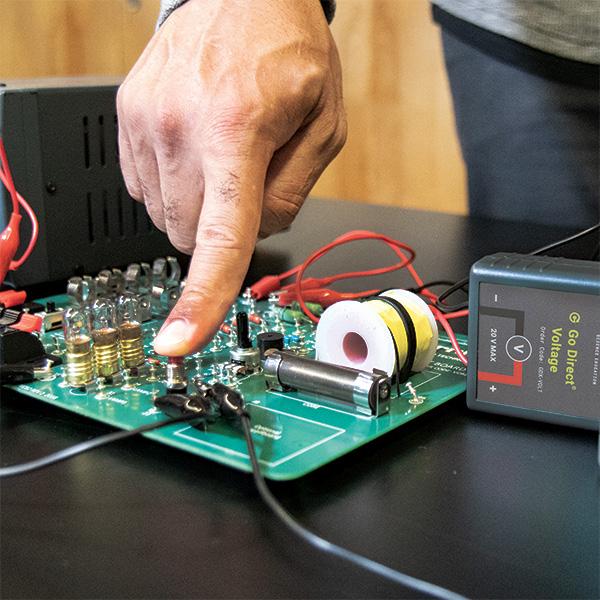
Understanding concepts like electric potential and energy transfer involves more than simply connecting wires and observing what happens in a circuit. To explain why a motor speeds up, a light dims, or a capacitor discharges, students must measure and analyze voltage changes the same way scientists and engineers do in real-world applications.
The Go Direct® Voltage Probe helps students move beyond identifying whether a circuit “works” to collecting precise voltage data they can use to quantitatively explore electrical principles.
Using this wireless probe, students can investigate voltage in a variety of investigations that explore Ohm’s law, Faraday’s law, series and parallel circuits, RC and RLC circuits, electromagnetic induction, and more. The probe combines a wide input voltage range and high precision, allowing students to quickly and accurately begin collecting real-time data for physics, physical science, engineering, and chemistry investigations.
Looking for some ideas to get started? Below are three hand‑picked, easy‑to‑implement investigations to engage high school and college-level students in hands-on physics. Each experiment can be done using the Go Direct Voltage Probe along with Vernier Graphical Analysis®.
Series and Parallel Circuits
Experiment #23 from Physics with Vernier
Level: High School and College
Have you ever noticed how removing one bulb from a string of holiday lights causes the entire strand to go out? However, when a light bulb is removed in your home—whether in the kitchen, bathroom, or hallway—the other lights stay on.
Understanding the difference between series and parallel circuits helps explain why this happens.
In this investigation, students use the Go Direct Voltage Probe and the Vernier Circuit Board 2 to analyze series and parallel circuits and compare how they function. By collecting and analyzing voltage data, students investigate circuits containing two resistors and apply Ohm’s law to determine the circuits’ equivalent resistance.
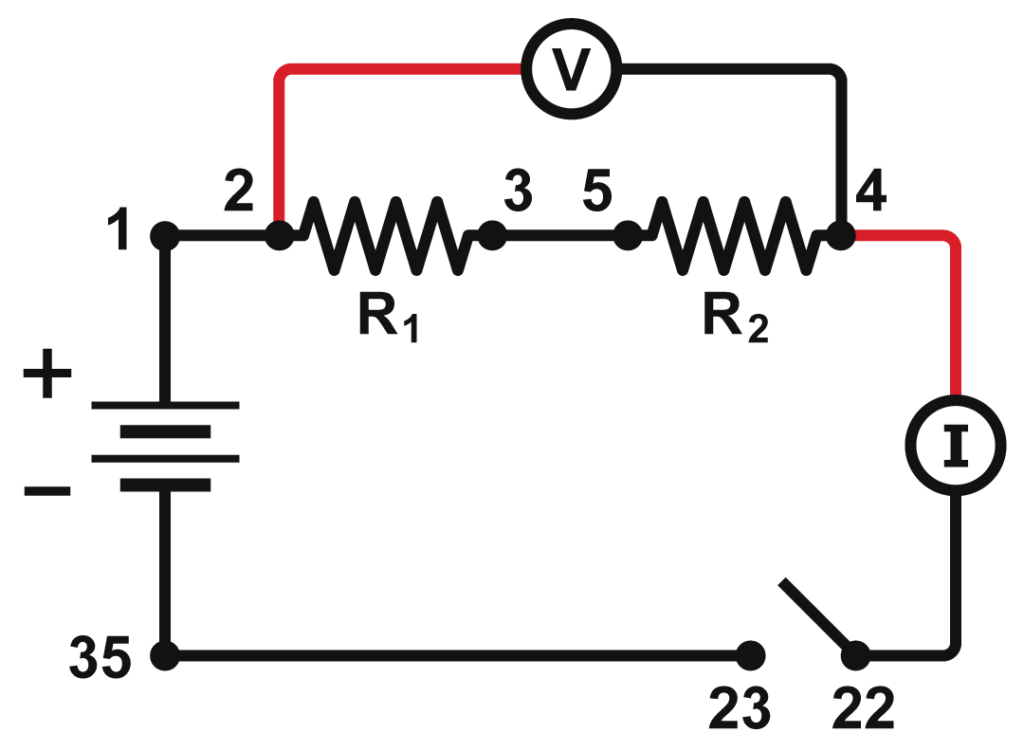
This classic introductory physics investigation is ideal for students who are first learning about electric circuits.
Objectives
- Study current flow in series and parallel circuits.
- Investigate potential differences in series and parallel circuits.
- Use Ohm’s law to calculate equivalent resistance of series and parallel circuits.
- Analyze and interpret data.
Energy Storage in Capacitors
Experiment #32 from Physics Explorations and Projects
Level: High School and College
One of the biggest advantages of the Go Direct Voltage Probe over a digital multimeter is that students can collect and graph electric potential data over time instead of only viewing a single voltage reading. This allows students to easily investigate RC circuits, as they do in this hands‑on, inquiry‑based activity exploring capacitors.
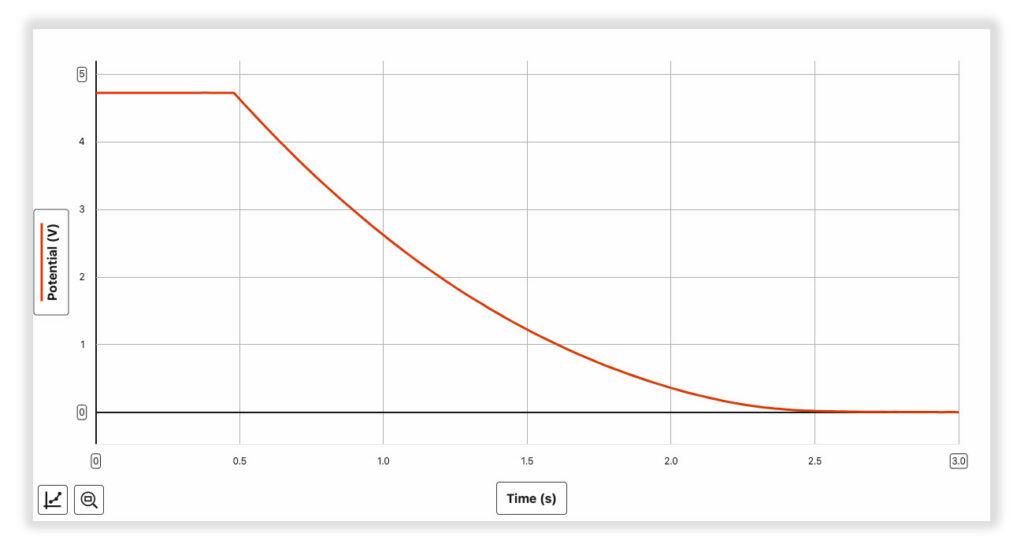
Capacitors are a common electronic component found in a wide variety of circuits and devices—everything from audio equipment to power supplies to sensors takes advantage of their unique energy‑storing capability. In this investigation, students explore how that works firsthand.
Students begin with preliminary observations, watching a simple RC circuit charge a capacitor and then discharge it through a light bulb. After reviewing how RC circuits work and discussing the energy transformations taking place, students design and conduct their own investigation using the Go Direct Voltage Probe to determine how charging voltage and capacitance each affect the amount of electrical energy a capacitor can store.
Objectives
- Plan and carry out an experiment.
- Understand that the energy stored in a capacitor is proportional to its capacitance and to the square of the voltage across it.
- Analyze and interpret data.
- Draw a conclusion from evidence.
Faraday’s Law: Moving Magnets
Experiment #11 from Advanced Physics with Vernier — Beyond Mechanics
Level: High School and College
Concepts like magnetic flux and electromagnetic induction are often taught through diagrams or simulations, making it difficult for students to fully understand how changing magnetic fields generate electric potential. This hands‑on investigation gives students the opportunity to explore these core physics principles by collecting and analyzing real data.
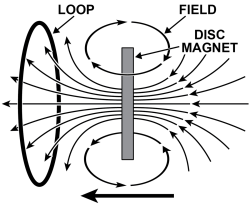
Using the Go Direct Voltage Probe, students build a simple coil and measure potential vs. time as a magnet moves through it. By analyzing the resulting graphs, students observe how changing magnetic flux induces an emf in the conducting loop and develop a deeper understanding of Faraday’s law and electromagnetic induction.
Objectives
- Plan and carry out an experiment.
- Fashion a simple coil to collect data.
- Collect potential vs. time data for a magnet moving through a coil.
- Account for features of the observed graph of potential vs. time.
- Relate the induced emf to changes in the magnetic flux passing through a oil.
- Analyze and interpret data.
Looking for more inspiration?
Watch our free, on-demand webinar, led by Vernier physics expert Josh Ence, for a walkthrough on how to incorporate the Go Direct Voltage Probe into various circuit lessons. Josh shares strategies for setting up quick, effective investigations that maximize class time for data analysis and discussion, as well as methods for guiding students to predict, test, and explain circuit behavior.
Beyond Physics: Electrochemistry Investigations
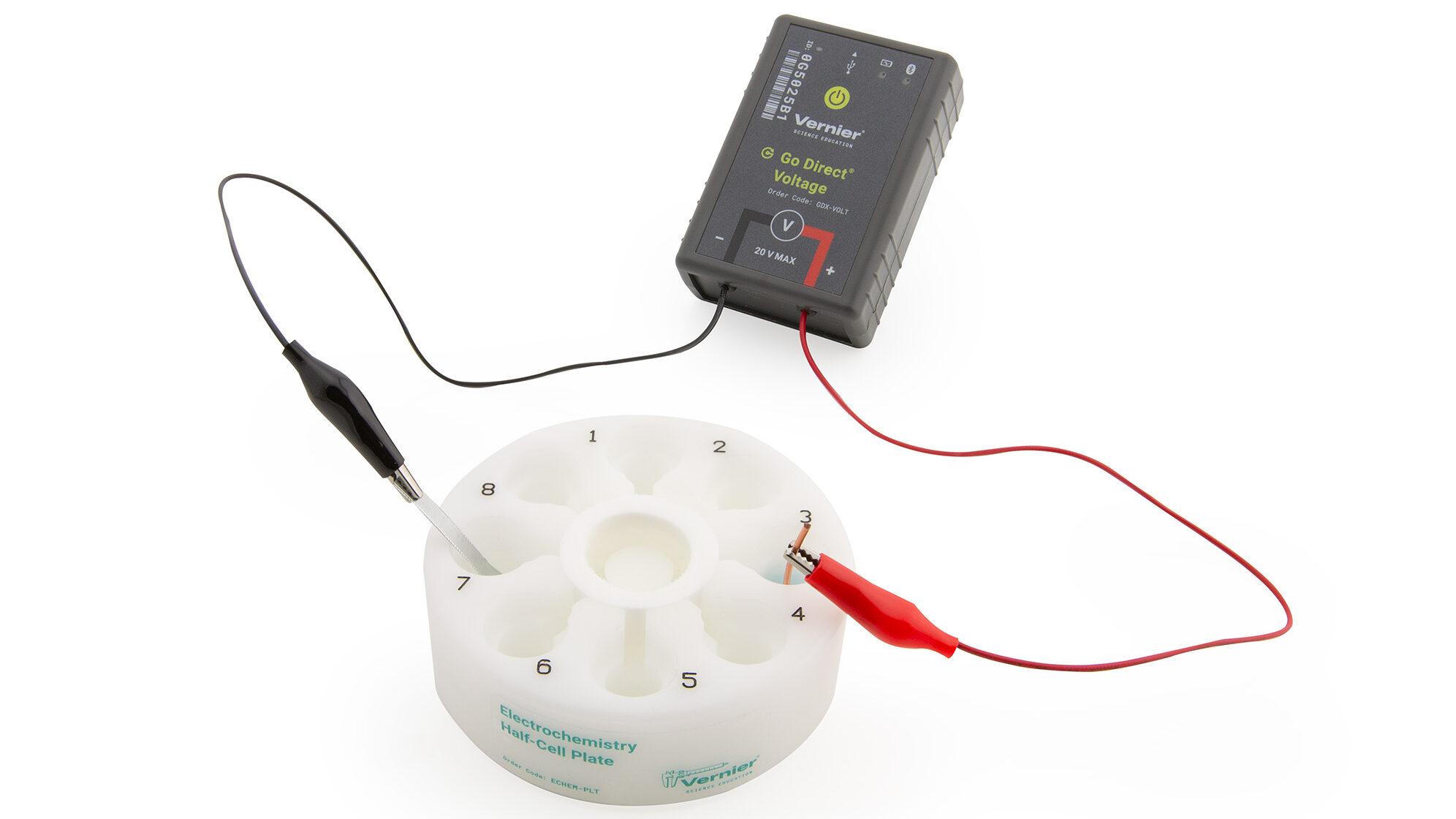
The Go Direct Voltage Probe isn’t just for physics. Chemistry students can use it to investigate voltaic cells and electrochemical reactions—for example, Experiment #28 from Chemistry with Vernier, “Establishing a Table of Reduction Potentials: Micro-Voltaic Cells,” has students measure the voltage between pairs of half‑cells to establish the reduction potentials of unknown metals. Get more electrochemistry inspiration here.
How are you using the Go Direct Voltage Probe in your STEM classroom? Let us know what you’ve done by sharing with us on social! Questions? Reach out to physics@vernier.com, call 888‑837‑6437, or drop us a line in the live chat.
Share this Article
Related Articles





Sign up for our newsletter
Stay in the loop! Beyond Measure delivers monthly updates on the latest news, ideas, and STEM resources from Vernier.