Sharing ideas and inspiration for engagement, inclusion, and excellence in STEM
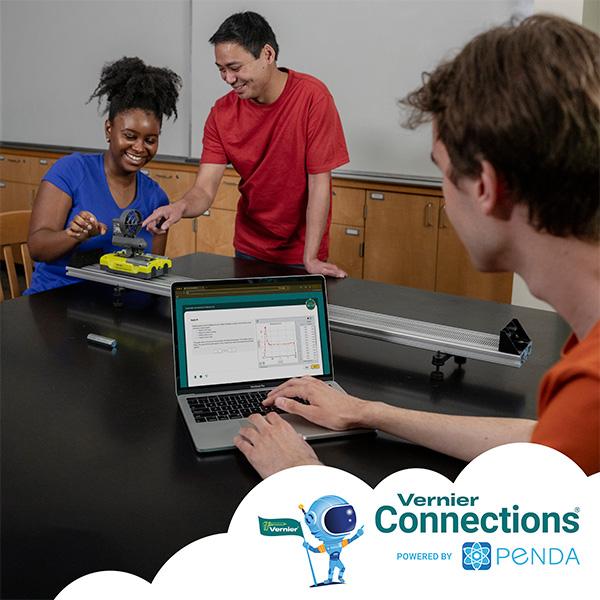
At Odessa High School in Ector County ISD in Texas, physics teacher and science department chair Rebecca Orcutt has been an early adopter of Vernier Connections®—using the platform both in her own classroom and across her department.
Designed to support hands-on, three-dimensional science instruction, Connections brings together phenomenon-based lessons, hands-on investigations using Go Direct® sensors, simulations, assessments, and actionable data into one digital platform.
In a recent webinar, Orcutt shared how teachers are using Connections day to day—and how those classroom practices are translating into time savings, stronger student engagement, clearer instructional insight, and improved performance on high-stakes assessments.
Saving Time Where It Matters Most
For teachers balancing labs, planning, grading, and assessment, time is one of the most limited resources. At Odessa High School, one of the most immediate benefits teachers see with Connections is reduced friction in daily planning and grading.
That efficiency starts with intentional setup. Vernier’s team hand-aligns Connections lessons to Ector County ISD’s pacing calendars, so teachers are working from resources customized to their district’s scope and sequence.
“When you’re looking at our pacing calendar or pacing guides, and you’re in a unit, you can just click on the link, and it’ll take you directly to that activity,” Orcutt said. “Everything is linked.”
Instead of navigating multiple platforms or folders—and wondering whether they’ve found the right resource—teachers can quickly access activities that are already aligned to their standards and unit focus. Over the course of a week, those saved minutes add up.
When Orcutt talks with colleagues about Connections, one feature comes up again and again.
“Everybody raves about the auto-grading,” she said.
Automatic feedback allows teachers to assign meaningful work without delaying responses to students. Because feedback is immediate, students can connect it to their thinking in the moment, while teachers maintain the ability to review and override grades when needed.
“The time-saving factor of it is huge,” Orcutt added.
Deepening Student Engagement and Understanding Through Hands‑On Learning
For Orcutt, the instructional payoff of that time savings shows up most clearly in student engagement during lab work with Connections.
“My students love when we do it,” she said. “They’re much more engaged. The discussions that they have about the data and how to analyze it have gone up tenfold.”
She’s also seen noticeable growth in how students explain their reasoning and apply what they’ve learned, especially when compared to traditional paper-based labs.
“Even if I had done a similar lab just on paper,” Orcutt explained, “by being able to have the graphics and the visuals that come with the Connections lab activities, it helps build that deeper understanding. Then they can apply it to additional situations.”
That engagement is reinforced by how investigations are structured. Because students collect and analyze their own data, shortcuts become much harder to take.
“With the lab data, they can’t just pull up ChatGPT or use Google Lens to find an answer,” Orcutt said. “The data they collect is always unique, so they have to use their own data to answer the questions.” Even when students are collaborating together, they’re still accountable for carrying their own thinking through each step of the investigation.
Using Data to Help Guide In‑Classroom Instruction
Beyond engagement, Connections gives teachers more actionable insight into student thinking between formal assessments. Beyond just assessment scores, teachers can look more closely at how students are approaching questions.
“You can see the difference between: Are students having trouble breaking down the question? Or are they having trouble with the content behind the question?” Orcutt explained.
That distinction helps teachers make instructional decisions in real time—whether it means reteaching a concept, regrouping students, or assigning targeted practice—while learning is still happening.
Supporting Diverse Learners in the Lab
Orcutt also described how Connections supports her large population of emergent bilingual students.
“My school is about 37 percent emergent bilingual,” she said. “Those students can go in, change the reading level, change it to their native language, and compare words.”
Connections includes built-in translation tools that support more than 100 languages, allowing students to access science content without being limited by language barriers. Seeing vocabulary in both languages helps students make meaning without losing access to the science.
“Sometimes they know an idea—they just don’t know how to translate it,” Orcutt explained. “When they can see the word in their native language and in English next to each other, they’re able to make that connection.”
Connecting Classroom Practice to Test Performance
Orcutt has also seen the way students work in Connections carry over into high-stakes assessments, particularly in AP Physics, where experimental design is a major focus.
“When I started using Vernier for the first time, we saw growth in our AP Physics scores,” she said. “One of the big questions in AP is the experimental design question. It doesn’t matter which kind of science you’re teaching—they all have an experimental design component.”
Before using Connections, she noticed that students often struggled to earn points on those questions. Not because they didn’t know the content, but because they got bogged down in the structure of traditional lab reports.
“They might only get three or four of the twelve available points,” Orcutt explained. “Now the average is closer to seven out of those twelve points because they’re better able to follow the process of a lab.”
That improvement comes from repeated, structured practice. Connections models the kinds of investigations students are expected to reason through on exams, and built-in practice assessments help students become familiar with high-stakes testing questions and the digital testing environment—so they can focus on applying their understanding rather than figuring out the format.
Flexible Enough to Fit Real Classrooms
While time savings, engagement, data insight, and outcomes are driving benefits, flexibility is what makes Connections workable across different classrooms.
Teachers in Orcutt’s department use the platform in a range of ways, depending on their instructional goals.
“I have some teachers who use it just for intervention,” she said. “I have some teachers who use it with the whole group and use the full lessons. In my classes, I use it for the hands-on investigations, for the upper-level labs with the independent analysis of the data.”
Others use specific components to support daily instruction, whether that’s using simulations or the assessments as warmups at the beginning of class, or as exit tickets to assess mastery of that day’s content.
That flexibility makes Connections easier to integrate into existing lessons and routines, to enhance three‑dimensional instruction without requiring teachers to redesign how they already teach.
Modernizing Labs While Still Centering Hands‑On Learning
From Orcutt’s perspective, the value of Connections ultimately comes down to how it strengthens lab-based science instruction.
“It’s a great way to modernize our science labs and bring in the digital learning component, so everything’s not just paper and pencil like it used to be,” she said.
“With Connections, it really is that perfect hybrid between physical hands-on lab experiments and the digital platforms that students need to be successful.”
Ready to see how Connections can help solve science instruction challenges in your school or district?
AP and Advanced Placement Program are registered trademarks of the College Entrance Examination Board, which was not involved in the production of and does not endorse these products.
Share this Article
Related Articles



Sign up for our newsletter
Stay in the loop! Beyond Measure delivers monthly updates on the latest news, ideas, and STEM resources from Vernier.