
The Instrumentation Amplifier monitors voltages from 20 mV to 1 V (DC or AC). It has several switch settings to allow you to select the best gain and includes auto-ID functionality for each of the six ranges. Input bandwidth of 10 kHz allows the capture of higher frequency signals. It is typically used to amplify the chart recorder or analog output of any instrument, such as a third-party gas chromatograph.
Menu
Instrumentation Amplifier
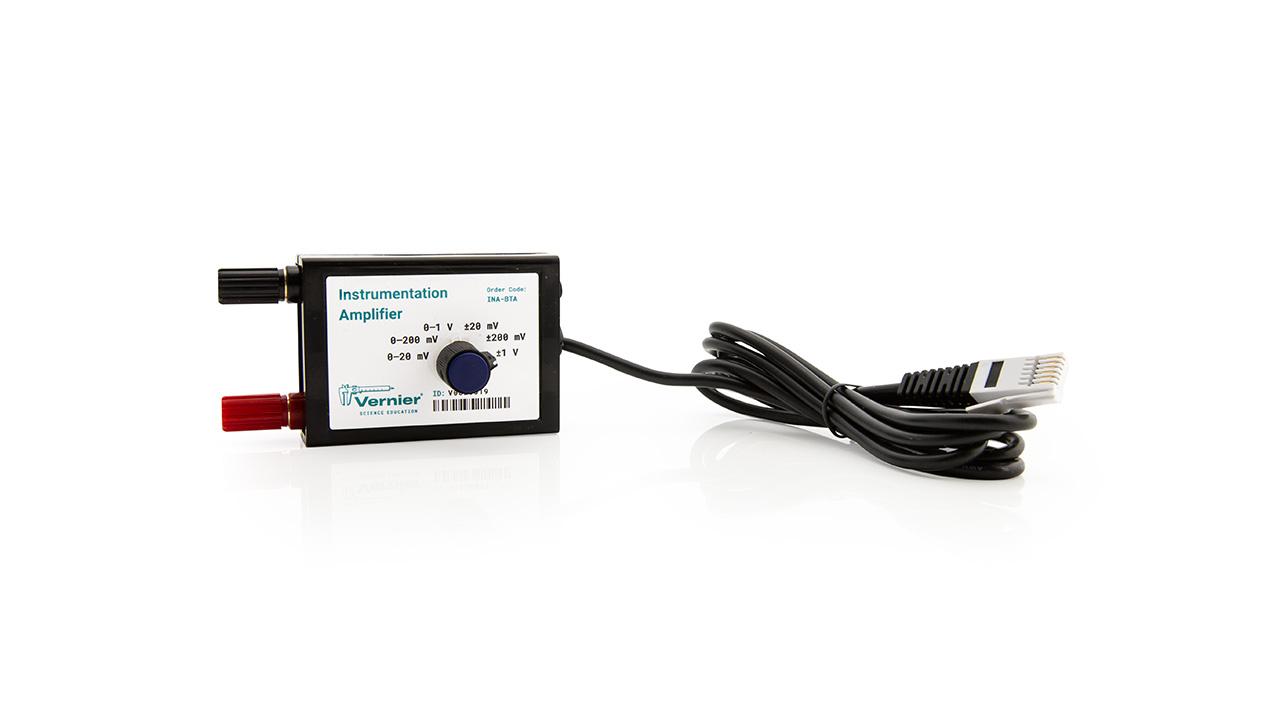
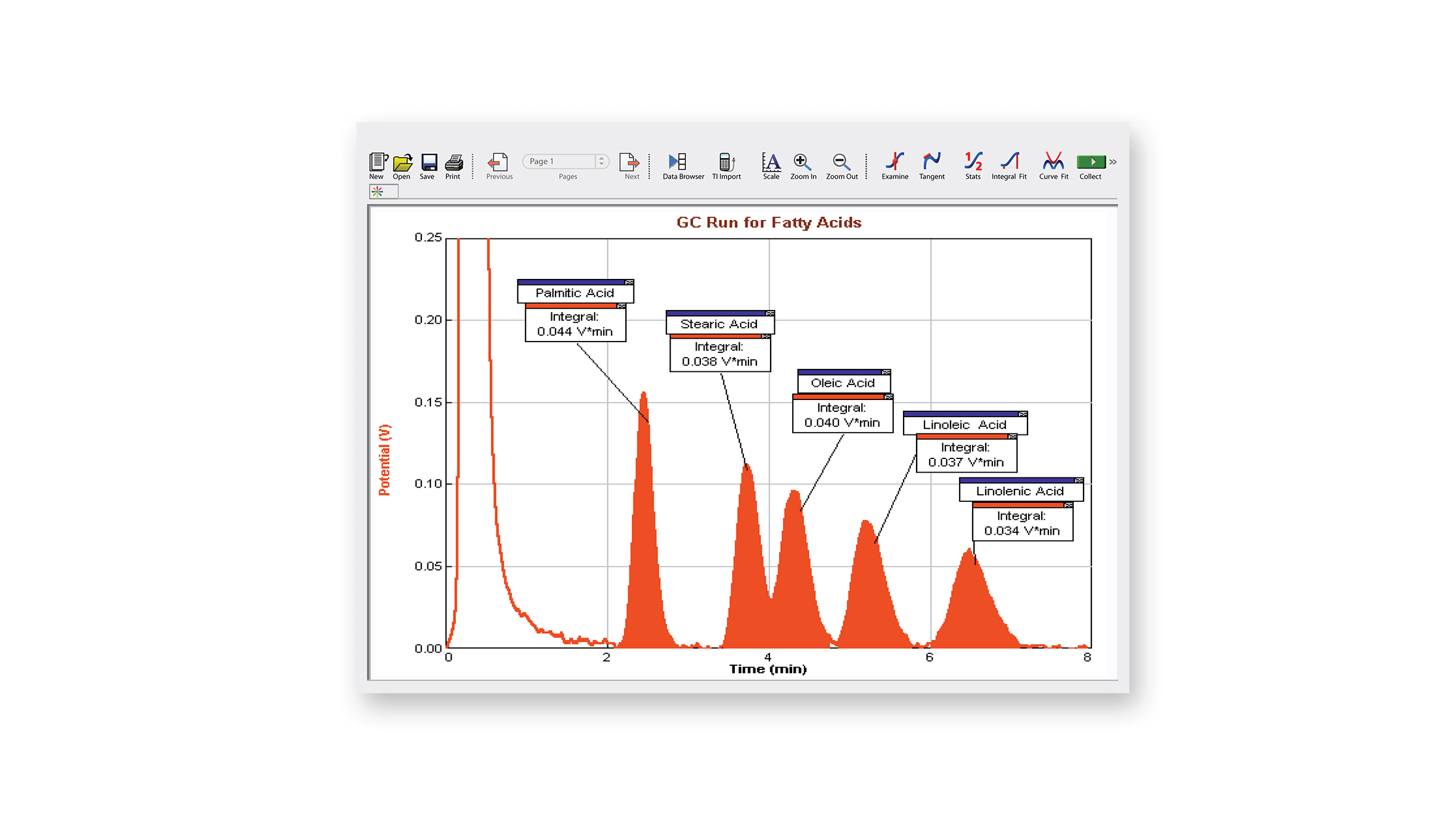
Amplify an instrument's chart recorder output
Instrumentation Amplifier
$105.00
The Instrumentation Amplifier can be used to connect a wide variety of measurement equipment to a Vernier interface and electronically collect, store, and analyze the data.
ORDER CODE:
INA-BTA
Category Sensors
Specifications
- Gain settings: 150, 75, 7.5, 15, 3, and 1.5±5%
- Linearity: 1%
- Power: 2.5 mA @ 5 VDC
- Frequency Response: 0-10 kHz (f3dB)
- Impedance: 1 MΩ to ground
- Range settings: 0-20 mV, 0-200 mV, 0-1 V, ±20 mV, ±200 mV, ±1 V
Experiments
High School (5 experiments)
College (5 experiments)
Requirements
Choose a platform below to see its compatibility requirements.
LabQuest
| Interface | LabQuest App |
|---|---|
| LabQuest 3 | Full support |
| LabQuest 2 | Full support |
| LabQuest | Full support |
Computers
| Software | ||||
|---|---|---|---|---|
| Interface | Graphical Analysis | Graphical Analysis (Web App) | Logger Pro (discontinued) | Logger Lite (discontinued) |
| LabQuest Mini | Full support | Full support | Full support | Full support |
| LabQuest 3 | Full support | Full support | Full support | Incompatible |
| LabQuest 2 | Full support | Full support | Full support | Full support |
| LabQuest Stream | Full support 1 | Full support 1 | Partial support 2 | Full support 1 |
| Go! Link | Full support | Full support | Full support | Full support |
| LabQuest | Full support | Full support | Full support | Full support |
| LabPro | Incompatible | Incompatible | Full support | Full support |
Compatibility Notes
- Connect LabQuest Stream via USB. Wireless connection is not supported.
- Bluetooth connection not compatible with macOS 11 and newer.
Chromebook
| Software | |
|---|---|
| Interface | Graphical Analysis (Web App) |
| LabQuest Mini | Full support |
| LabQuest 3 | Full support |
| LabQuest 2 | Full support |
| LabQuest Stream | Full support 1 |
| Go! Link | Full support |
| LabQuest | Full support |
Compatibility Notes
- Connect LabQuest Stream via USB. Wireless connection is not supported.
iOS
| Software | ||
|---|---|---|
| Interface | Graphical Analysis | Graphical Analysis GW |
| LabQuest Stream | Full support | Full support |
| LabQuest 3 | Full support 1 | Full support 1 |
| LabQuest 2 | Full support 1 | Full support 1 |
Compatibility Notes
- iOS and Android™ devices can only connect to LabQuest 2 or LabQuest 3 via Wireless Data Sharing.
Android
| Software | ||
|---|---|---|
| Interface | Graphical Analysis | Graphical Analysis GW |
| LabQuest Stream | Full support | Full support |
| LabQuest 3 | Full support 1 | Full support 1 |
| LabQuest 2 | Full support 1 | Full support 1 |
Compatibility Notes
- iOS and Android™ devices can only connect to LabQuest 2 or LabQuest 3 via Wireless Data Sharing.
Arduino
| Software | |
|---|---|
| Interface | Arduino |
| Vernier Arduino® Interface Shield | Full support |
LabVIEW
| Software | |
|---|---|
| Interface | NI LabVIEW |
| SensorDAQ | Full support |
| Vernier myDAQ Adapter | Full support 1 |
| Go! Link | Full support |
| LabQuest Mini | Full support |
| LabQuest Stream | Full support |
| LabQuest 3 | Full support |
| LabQuest 2 | Full support |
| LabQuest | Full support |
Compatibility Notes
- You can only read the raw count/raw voltage output by this sensor. You must do the programming to convert to proper sensor units.
Texas Instruments
| Software | |||||
|---|---|---|---|---|---|
| Interface | EasyData | DataMate | TI-84 SmartView | DataQuest | TI-Nspire Software |
| EasyLink | Full support 1 | Incompatible | Full support 2 | Full support | Full support 2 |
| CBL 2 | Full support 3 | Full support 3 4 | Incompatible | Incompatible | Incompatible |
| LabPro | Full support 3 | Full support 3 4 | Incompatible | Incompatible | Incompatible |
| TI-Nspire Lab Cradle | Incompatible | Incompatible | Incompatible | Full support | Full support |
Compatibility Notes
- Use with TI-84 Plus calculators only.
- Requires an Easy to Go! adapter
- CBL 2 and LabPro interfaces cannot be used with TI-84 Plus CE calculators.
- DataMate cannot be used with color screen TI-84 Plus calculators; use EasyData with these calculators.
What's Included
- Vernier Instrumentation Amplifier
Accessories
Support
Warranty
5-year limited warranty
See our warranty policy
Contact Us
- Recommended: Online Support
- Email: support@vernier.com
- Toll-free: 1-888-837-6437
Educational use only: Vernier products are designed for educational use. They are not appropriate for industrial, medical, or commercial applications.