Sharing ideas and inspiration for engagement, inclusion, and excellence in STEM

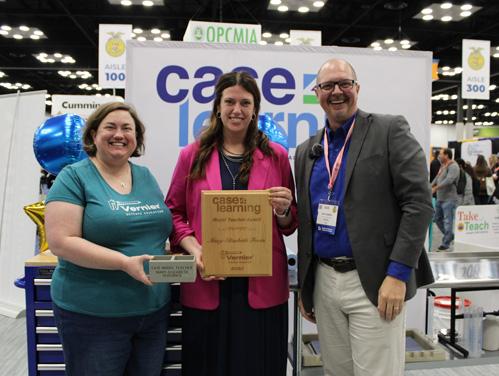
Mary-Elizabeth Foote teaches agricultural science at Schuylerville High School in upstate New York, where she uses CASE 4 Learning curriculum and Vernier technology to support hands‑on, inquiry‑driven learning. Now in her ninth year in the classroom and recognized as a 2025 CASE Model Teacher, she shares how hands‑on, real‑world investigations and technology help students take ownership of their learning.
What led you to become an agriculture science educator, and what kind of program do you teach?
I grew up on a working dairy farm, and my mom was a high school agricultural educator for 34 years, so agriculture and teaching were always part of my life. I kind of knew I was going to end up in the classroom, but I wanted some industry experience first. I worked for the Center for Dairy Excellence in Pennsylvania for about two years, doing dairy education programs for both elementary and high school students, and that really shaped how I think about teaching and the importance of real‑world connections.
I teach at a traditional high school, and I work with students from ninth through twelfth grade. We don’t require students to commit to a single pathway or stay in agricultural science all four years. Instead, students can pick and choose classes based on their interests. I teach Introduction to Agriculture, Animal Science, Plant Science, Food Science, Ag Business, and Advanced Animal Science and Veterinary Medicine, and I use CASE curriculum across all of those courses.
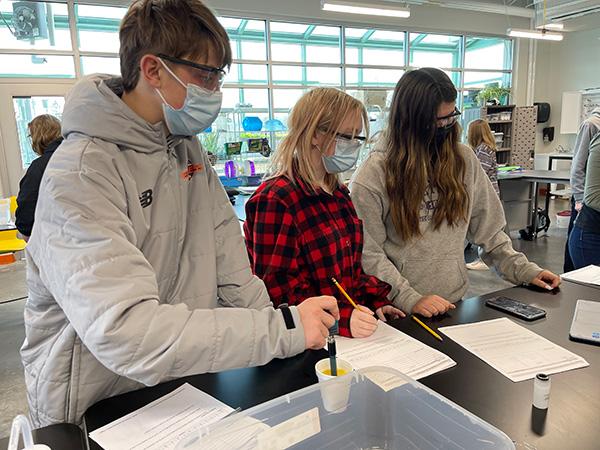
What I really like about our program is that students come in with very different backgrounds. We have students from farms, students from the suburbs, and students who have never touched an animal before. Many of them don’t come in with clear career goals, and that’s okay—our goal is to introduce students to agriculture, help shape those interests, and maybe spark a passion they didn’t know they had.
Because we’re not a career tech center, students aren’t restricted to one pathway. Some students stay with us all four years, while others might take Animal Science and then go on to a small animal program at a local career tech center—or head in a completely different direction, like welding. I think that flexibility is one of the coolest parts of how we teach—it gives students the opportunity to see a lot of different options and figure out what fits them best.
Why do hands-on, inquiry-based investigations matter so much in your agriculture classes?
There are three big reasons why I think hands-on, inquiry-based learning matters so much.
The first is engagement. When students are actually in charge of their own learning, they’re more engaged. I can sit at a Promethean all day and give a presentation, but it’s not until students are doing something with their hands and really taking control of their own learning that they’re engaged in it.
The second reason is ownership. Students start to become almost like scientists or professionals, and they really take ownership of the exploration and of wanting to do it. That’s the fun part for me as a teacher, watching them take that responsibility and get invested in what they’re figuring out.
And the third, and probably biggest reason, is that this is real-world learning. In agriculture classrooms and career and technical education, we’re constantly utilizing information students are learning in other classes—math, science, even social studies and ELA—and they get to bring it all together and see it in action. They’re seeing how these subjects actually matter in a real-world setting.
You can talk about pH, ions, and all kinds of chemistry concepts, but until students see how these concepts affect a plant, an animal, or even the food they eat, they don’t fully click. That’s why hands‑on, inquiry‑based, experiential learning is so important.
How does Vernier technology fit into your classroom, and how do students respond to using it?
My district is one-to-one, so the wireless Go Direct® sensors really made sense for my classroom. I have about 10 different sensors, including temperature, CO2 gas, optical dissolved oxygen, conductivity, and both the standard and flat pH sensors. I also have the Go Direct turbidity, gas pressure, and the SpectroVis® Plus Spectrophotometer, as well as the original Soil Moisture Sensor, although Vernier now offers the Go Direct version.
My students really love using Vernier sensors, and I remember one of the first moments when I felt like I had really figured out how to implement CASE in my classroom. My class was completing a CASE AFNR activity (3.2.3 Acids and Bases), where students quantify the pH of a substance using the Vernier Graphical Analysis® app and the pH sensor. The students really just “got it.” They quickly figured out how to use the sensors with their Chromebooks™ and the online Graphical Analysis software. Once they got started, I didn’t really have to help much—and one student even turned to me and said, “I feel like a scientist!”
Because I have so many different sensors, we can do pretty much any CASE APP (Activity, Project, or Problem), but I can also modify as needed, expand projects, and even create my own investigations. However, the only real way to do this is by taking the time for students to learn how to use the sensors and to respect the equipment, like they would in a real-world setting. Once they figure that out, learning really becomes limitless.
What kinds of investigations do your students do using Vernier sensors?
We use Vernier sensors across most of the courses I offer, so we do a wide variety of investigations. Starting in 9th grade, students utilize temperature, pH, gas pressure, turbidity, and dissolved oxygen sensors. They begin by learning how to use the sensors and then apply them to explore pH, acids, and bases. Then they start to design and conduct their own water-quality experiments and see how plants and animals depend on each other for survival, especially in waterways.
In Plant Science, students do a lot with soil chemistry. They measure soil pH and track how it changes after we modify it. They also monitor soil salinity and soil moisture. Hydroponics is a month-long unit for us, so students not only use pH sensors, but also the dissolved oxygen and conductivity sensors to monitor water systems. The other sensor we use in Plant Science is the gas pressure sensor, which students use in an activity exploring the process of osmosis and the importance of turgor.
In Animal Science, we use the temperature sensor. Specifically, students measure the temperature of water while burning two different feedstuffs to determine their energy content.
In Food Science, we use the pH sensor to look at the pH of food items and the gas pressure sensor to measure the amount of CO2 gas produced in a chemical reaction with varying pH levels.
Because students are using real-world equipment and collecting their own data, they really do start to think and act like agriscientists—and my students really love it.
Looking ahead, what excites you most about where your program—and your students—are headed?
I am just excited to continue to dive headfirst into activities, projects, and real-world problems with my students, leading with inquiry-based learning—and getting deeper into the CASE curriculum. Just today, I taught six different periods with five preps, doing everything from analyzing the nutrient content of foods to investigating the impact of pH on nutrient absorption. My students were engaged, hands-on, and loving it—I am excited to continue to see more of that.
Learn more about how Vernier supports agricultural science, CASE, and other career and technical education. Questions about our sensors? Reach out to support@vernier.com, call 888-837-6437, or drop a question in our live chat!
Share this Article
Related Articles


Sign up for our newsletter
Stay in the loop! Beyond Measure delivers monthly updates on the latest news, ideas, and STEM resources from Vernier.