
Sharing ideas and inspiration for engagement, inclusion, and excellence in STEM
I’ve been teaching science since 2000, and the question that’s driven me from the start is a simple one: How do I make science learning feel real and relevant for my students? Early on, that meant writing grants in a rural school just to get basic equipment. It meant looking for ways to go beyond cookbook labs and actually put data in students’ hands.
Over time, that question led me to two things I now build my entire course around: case‑based teaching and real‑time data collection with Vernier technology. What started as a small shift has grown into a classroom approach where engagement is high, learning is meaningful, and students begin to see themselves in real‑world science and healthcare careers.
Why Case Studies Work: Turning Stories into Real‑World Problem Solving
Students connect to stories. Not summaries of content, not isolated vocabulary terms, but stories. When students are trying to figure something out, the way scientists and healthcare professionals actually do, they lean in. They ask questions. They argue with each other. They care about the answer.
Case studies give students that reason to care. The format I keep coming back to is the interrupted case study, where they get a little evidence at a time and have to revise their thinking as the story unfolds. The story comes first. The labs follow from it. This approach works well across science disciplines, but it’s especially powerful in human anatomy and physiology, where the phenomena are personal, the stakes feel real, and the connection to healthcare careers is right there on the surface.
Bringing a Case Study to Life: The Marathon Runner
One of my favorite examples is the Marathon Runner case study, which I adapted for use with Vernier technology. The premise is straightforward—a marathon runner slips into a coma, and students have to figure out why. Students work through four diagnostic questions, gathering evidence and building toward a final diagnosis.
What I love about this case is that it hooks students immediately. A lot of my kids are runners. They’re on track teams or run cross‑country. When they hear about an athlete collapsing during a race, they want to find out what happened.
Once the story is established and students have started asking questions, that’s when we bring in the data. Each diagnostic question becomes its own investigation, with a Vernier sensor at the center of it.
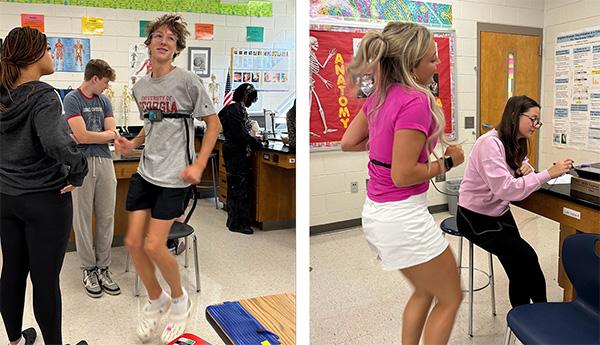
For the question Did the marathon runner run out of oxygen?, students use the Go Direct Respiration Belt to measure their own breathing rates at rest and after exercise. They’re collecting real respiratory data and using it to make a claim—with evidence—about what might have been happening inside the runner’s body.
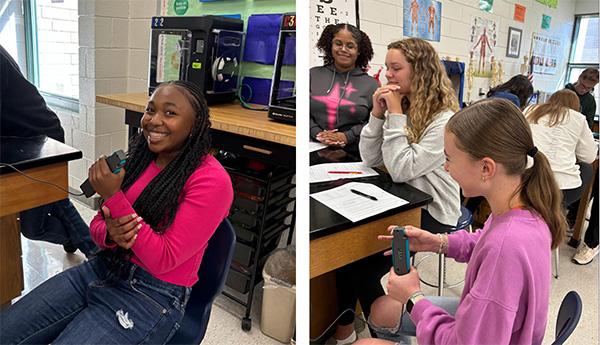
For the next question, Did the marathon runner run out of energy?, students use the Go Direct Hand Dynamometer to investigate muscle fatigue through continuous and repetitive grip exercises, tracking how maximum force changes over time. In past years, I had students squeeze clothespins to simulate fatigue. It works, but it’s qualitative at best. With the dynamometer, students can quantify exactly how force drops over time, compare continuous versus repetitive gripping, and connect that data to what’s happening at the cellular level—including the role of glucose and energy depletion. That’s a very different experience.
Run With It: How One Case Study Kept Growing
The Marathon Runner case opened a door I didn’t expect. Once I saw what was possible—pairing a compelling story with real data collection—I couldn’t stop asking: What else could we do with this? It really ignites your own creativity as a teacher.
I had already written a grant to get a wound-packing kit for my classroom—the kind used to train people to stop a bleed. And as I was thinking about how to use it, something just sparked. I thought: How can I quantify this? How can I make this more in-depth and really connect my students to what they’re learning?
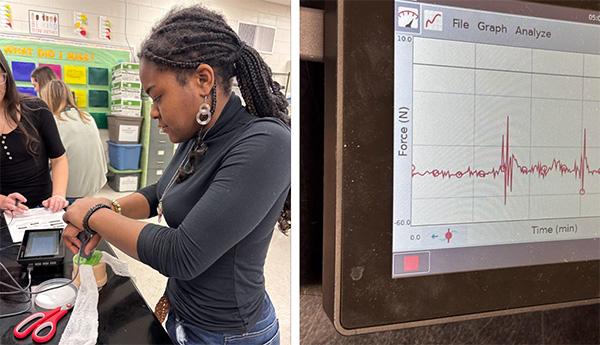
I ended up connecting with the Vernier Science Solutions team, and their engineers actually designed a custom adapter I could 3D print, so we could attach force sensors to the wound‑packing model. Suddenly, students could see in real time how much pressure they were applying, watch it on the LabQuest, and understand exactly why sustained, consistent force is what stops a bleed. And when I realized I needed more, I just walked down the hall to the physics teacher and asked if I could borrow a Force Plate. That worked too!
This wasn’t a lab from a book. It grew out of curiosity and conversation and a willingness to try something that hadn’t been done before. And it connected directly to careers in a way that felt real—not manufactured.
Several of my students are in our school’s HOSA Future Health Professionals program, and they were hosting a Stop the Bleed competition the very next day. They were practicing in my anatomy class and competing the next morning. That kind of overlap—where the science classroom and the real world are doing the same thing at the same time—is exactly what I’m always chasing.
Connecting Classroom Science to Careers
Gen Z students need to see the connection between what they’re learning and where it could take them. When the science in your classroom looks like the science in a hospital, a research lab, or an emergency response situation, students start to picture themselves in those roles, and that changes how they engage.
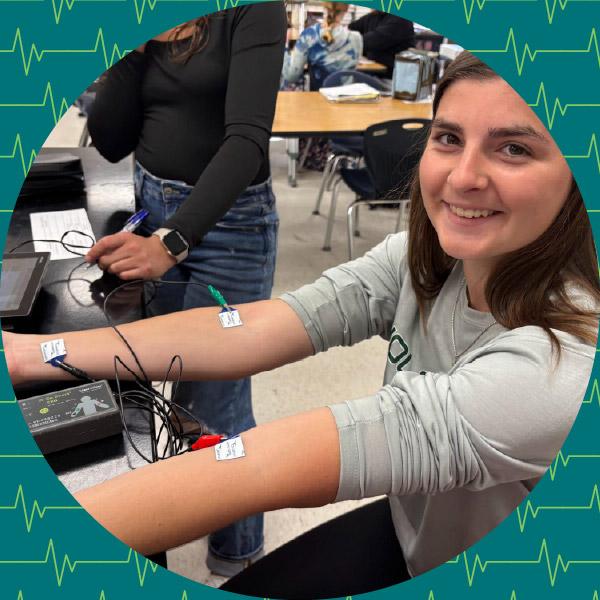
Through additional grant funding, my students have used EKG sensors to examine their own sinus (cardiac) rhythms. Watching your own cardiac data appear on a screen has a way of making physiology feel very personal—and it opens up exactly the kinds of questions that matter in health science pathways: What does a normal rhythm look like? What happens when it isn’t normal? The next step is having students design 3D‑printable solutions to heart problems, moving from understanding how the body works to asking what we do when it doesn’t. That’s the kind of thinking that prepares students for careers in healthcare, biomedical engineering, and beyond.
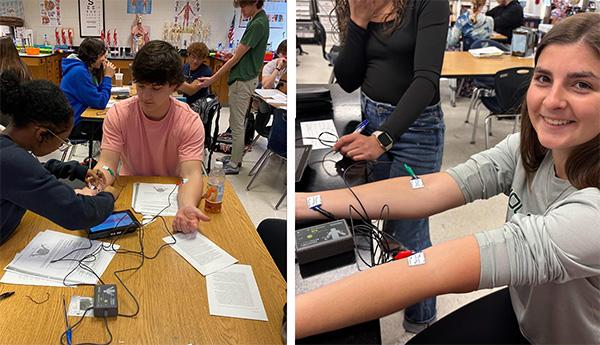
The goal is ultimately to move students from solving cases to creating their own. As a culminating project, I’m building toward a “mock physical exam” experience where student teams use multiple Vernier sensors to collect patient-style data and design their own exam protocol. Then they take everything they’ve learned and apply it in a new, creative way.
Tips for Getting Started with Case‑Based Teaching
If you’re thinking about trying case‑based teaching in your own classroom, you don’t have to start from scratch. Here’s the approach that’s worked for me:
- Start with a relevant phenomenon. Relevance drives everything, especially for high school students.
- Use an existing case study and adapt it. The NSTA Case Collection is a great starting point, with cases spanning biology, chemistry, physics, and more.
- Ask: How can I quantify this? This question is what opened this whole world up for me. Look for places where a Vernier sensor can replace estimation with real data.
- Use the interrupted format. Reveal the story in parts. Let students build their understanding as new evidence arrives.
- Let one idea lead to the next. You don’t have to have it all figured out at the start.
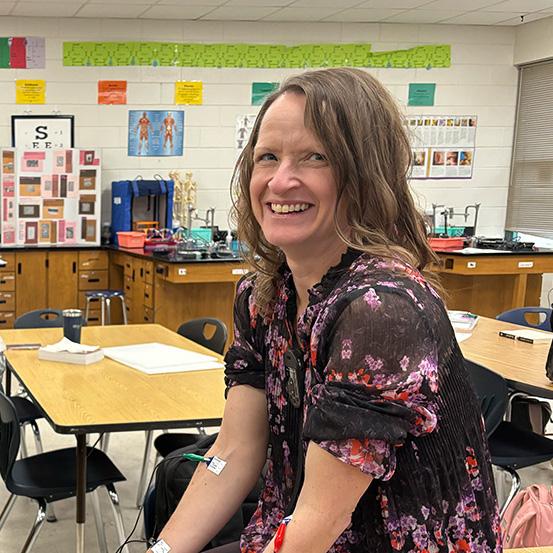
Crystal McDowell is an AP Biology and Human Anatomy and Physiology teacher at Greenbrier High School in Evans, Georgia. She has been teaching science since 2000 and holds an Ed.S., with graduate research focused on case‑based teaching. Crystal is a Vernier Trendsetter and is passionate about helping students see the relevance of science through storytelling, real‑time data collection, and career‑connected learning.
Share this Article
Related Articles

Sign up for our newsletter
Stay in the loop! Beyond Measure delivers monthly updates on the latest news, ideas, and STEM resources from Vernier.