
Sharing ideas and inspiration for engagement, inclusion, and excellence in STEM
Students observe motion constantly—objects falling, rolling, colliding—but making sense of why that motion looks the way it does can be challenging. Why does a dropped phone fall straight down, while a ball launched from a table follows a curved path? Why does a skateboard speed up on a ramp but slow down on level ground?
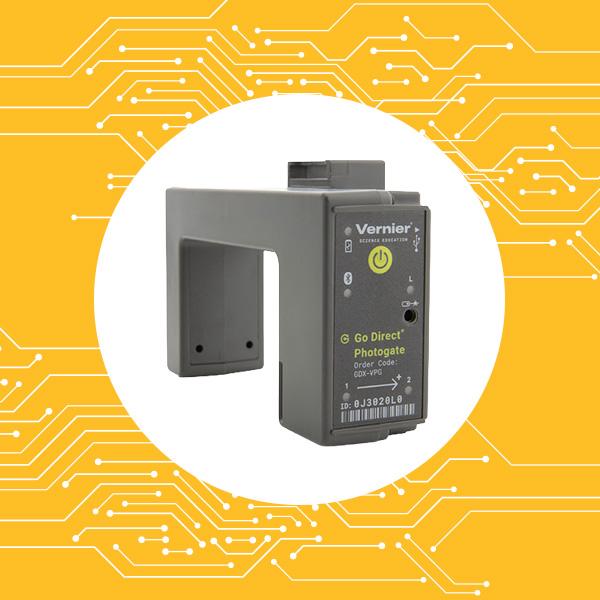
The Go Direct® Photogate helps students move beyond observation to explanation. By collecting precise timing data, students can measure velocity and acceleration directly and connect everyday motion to core concepts in kinematics and Newton’s laws.
With two built‑in photogates plus a single laser gate for objects passing outside the arms, this versatile sensor supports investigations of free fall, projectile motion, collisions, and more.
Looking for some ideas to get started using this popular sensor? Below are three hand-picked, easy‑to‑implement investigations to engage high school and college‑level students in hands‑on physics. Each experiment can be done with the Go Direct Photogate along with Vernier Graphical Analysis®.
Picket Fence Free Fall
Experiment #5 from Physics with Vernier
Level: High School and College
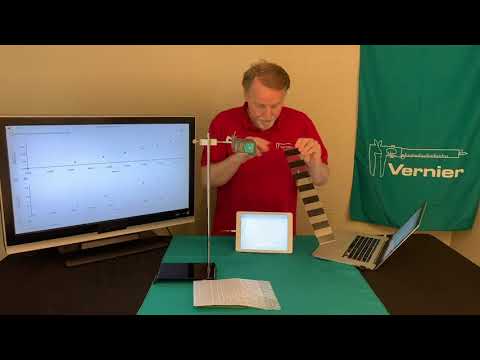
Free fall can feel abstract to students, but it’s a type of motion they often encounter in the real world, from a dropped set of keys to a diver accelerating under gravity. This investigation gives students a clear, data-based way to explore what “constant acceleration” actually means.
In this investigation, students measure the acceleration of a freely falling object, g, using a picket fence and the Go Direct Photogate. The picket fence is a clear plastic strip with evenly‑spaced black bars. As it falls through the photogate, the device measures the time from the leading edge of one bar blocking the infrared beam to the next. This continues for all eight bars, providing students with precise velocity and acceleration data to analyze this type of motion.
For advanced students, you can extend the activity with the “Error Analysis” investigation from Advanced Physics with Vernier. Rather than measuring g a few times, students measure the falling picket fence dozens of times to determine how much uncertainty there is in the measurement. This activity is a great hands-on way for students to explore experimental methods as they collect and analyze data.
Objectives
- Plan and carry out an experiment.
- Measure the acceleration of a freely falling body (g) to better than 0.5% precision using a picket fence and a photogate.
- Analyze and interpret data.
Projectile Motion
Experiment #8A from Physics with Vernier
Level: High School and College
When an object rolls off a table—whether it’s a pencil, a marble, or a ball—students often assume its forward motion affects how quickly it falls or where it will land. This investigation helps them test that assumption with data.
Using a Go Direct Photogate, students measure the horizontal velocity of a ball just before it leaves the table. The ball rolls down a ramp, passes through the photogate on the tabletop, and then leaves the edge of the table as a projectile before striking the floor some distance away. Because the Go Direct Photogate includes two built-in gates, it automatically calculates velocity from the time the ball blocks Gate 1 and then Gate 2—no second sensor required.
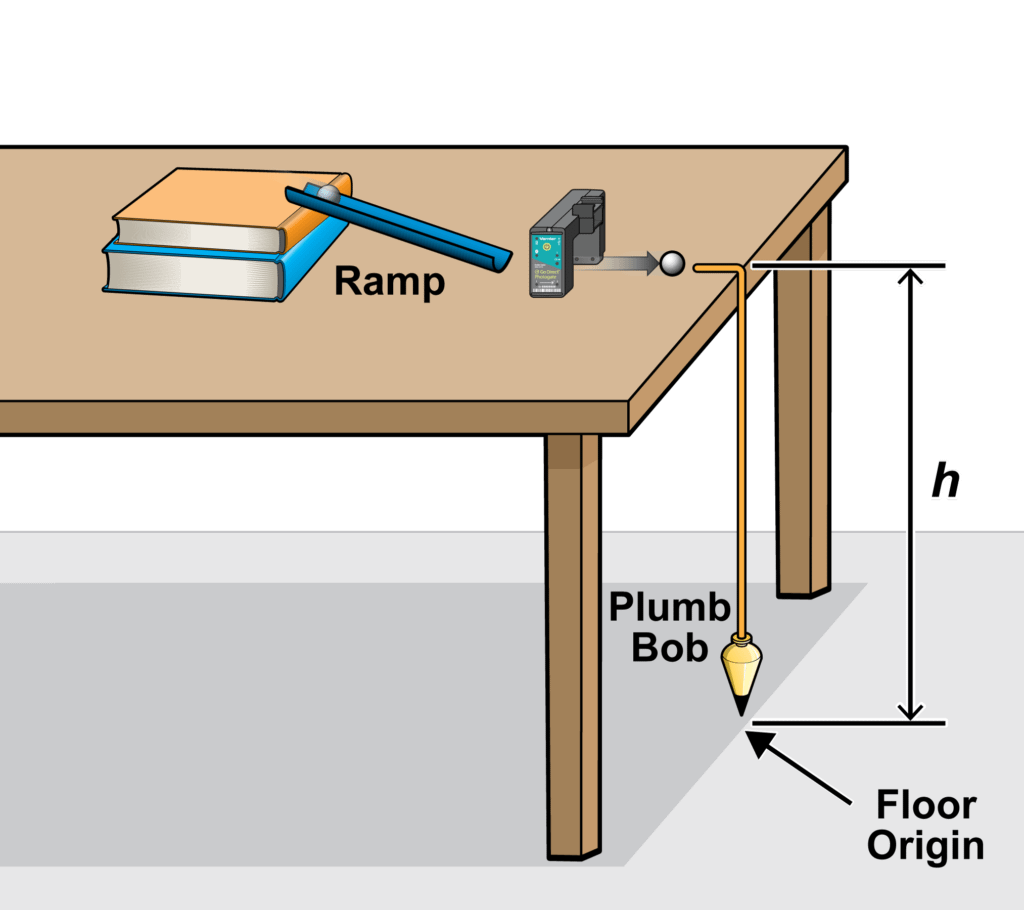
Students use the measured launch velocity and the table height to predict where the ball will land. After accounting for trial‑to‑trial variation in velocity, they test their prediction and compare the expected impact range to the actual landing point.
Objectives
- Plan and carry out an experiment.
- Measure the velocity of a ball using a photogate.
- Apply concepts from two‑dimensional kinematics to predict the impact point of a ball in projectile motion.
- Take into account trial‑to‑trial variations in the velocity measurement when calculating the impact point.
- Analyze and interpret data.
Atwood’s Machine
Experiment #10 from Physics with Vernier
Level: High School and College
An Atwood’s machine—an experimental setup consisting of two masses connected by a string over a pulley—may look simple, but it provides a powerful way for students to investigate how unbalanced forces produce motion. It’s the same underlying physics students experience during an uneven tug‑of‑war or when an elevator starts moving with a heavy load.
In this investigation, students use the Go Direct Photogate with Ultra Pulley Attachment to collect velocity data as one mass accelerates downward and the other accelerates upward. By graphing velocity versus time, students determine the system’s acceleration directly from their data.
Students run the experiment in two parts. First, they keep the total mass constant while changing the mass difference between the two sides. Then, they keep the mass difference constant while increasing the total mass. Comparing these two cases helps students tease apart how both force imbalance and system mass influence acceleration, allowing them to develop Newton’s second law from their lab experience.

Objectives
- Plan and carry out an experiment.
- Use a photogate to study the acceleration of an Atwood’s machine.
- Determine the relationships between the masses on an Atwood’s machine and the acceleration.
- Analyze and interpret data.
Taking the model further
To extend this investigation into a real-world system, check out Going Up? Exploring Mass, Motion, and the Mechanics of Elevators, available in our free 3D Investigation Sampler. In this investigation, students use the same Atwood’s machine setup to model elevator motion—then apply their data to questions of safety, efficiency, and engineering design.
Looking for more inspiration?
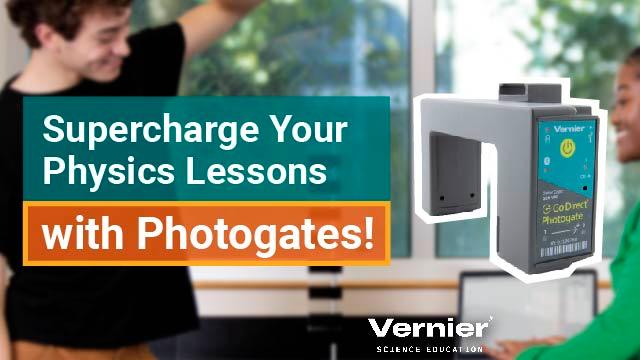
Watch our on-demand webinar, Stopwatches, Meter Sticks, and Velocity—Oh My! Enhancing Your Physics Instruction with Photogates, with Vernier physics expert Josh Ence, where he demonstrates how the Go Direct Photogate can transform common motion investigations.
How are you using the Go Direct Photogate in your STEM classroom? Let us know what you’ve done by sharing with us on social! Questions? Reach out to physics@vernier.com, call 888‑837‑6437, or drop us a line in the live chat.
Share this Article
Related Articles







Sign up for our newsletter
Stay in the loop! Beyond Measure delivers monthly updates on the latest news, ideas, and STEM resources from Vernier.