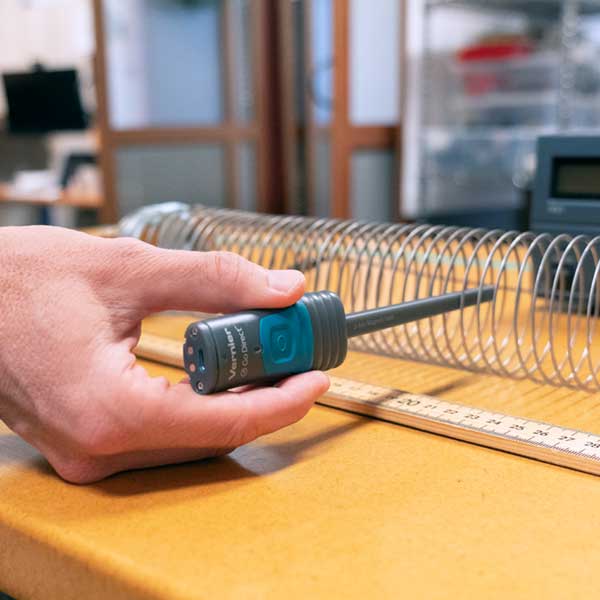
Looking for fresh ways to engage your students in the study of magnetic fields? Guide your students through the invisible forces that influence our world with the Go Direct 3-Axis Magnetic Field Sensor.
This versatile tool measures the comp...
As we gear up to welcome students back to the classroom, it’s the perfect time to strategically introduce (or reintroduce) the fundamental principles of data collection. No matter the subject, understanding how to collect, analyze, and interpret d...
One of the most versatile ways for students to measure motion—a key scientific concept—is the Go Direct® Motion Detector.
This sensor uses ultrasound to measure the position, velocity, and acceleration of moving objects. Specifically, the Go Dir...
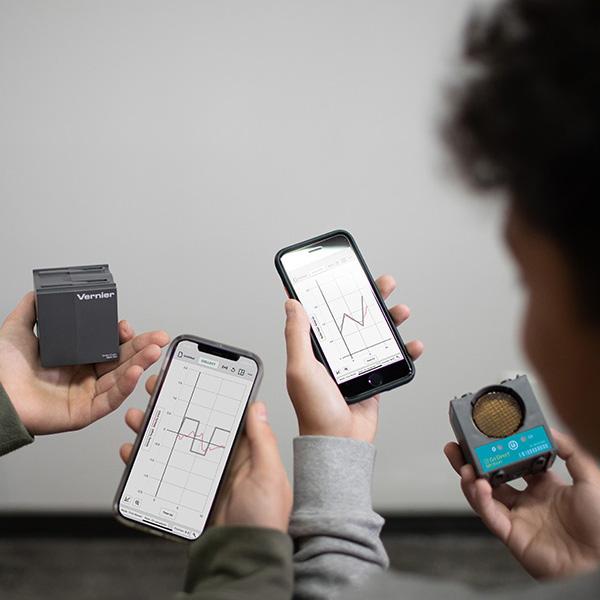
Energy, acceleration, and simple harmonic motion are just a few important physics principles for students to learn—and using the Graphical Analysis Pro app with our Go Direct® sensors can help bring these abstract scientific concepts to life.
...
At Vernier, our goal is to help all students become STEM-literate citizens. So, as we develop lessons for Vernier Connections, it is critical that we design a journey that will support the learning of all students.
This is why we decided to groun...
Understanding key physics concepts, such as Newton’s laws of motion, gives students a solid foundation for exploring real-world physics applications—and the Go Direct Force and Acceleration Sensor is a great tool for laying that groundwork and b...
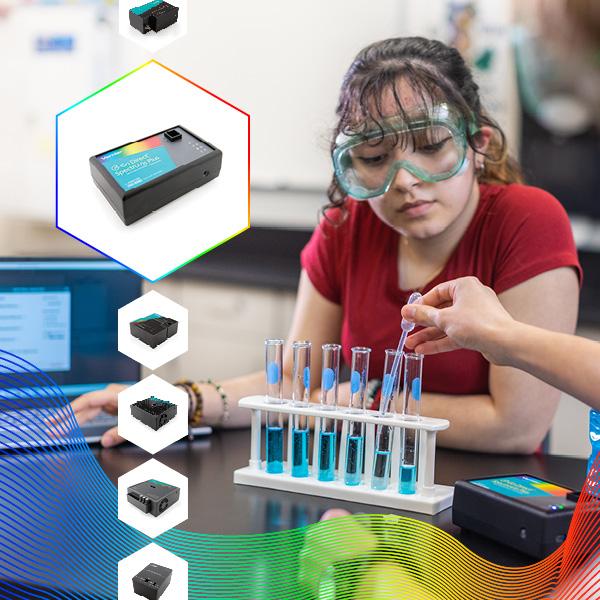
Spectrometers are a great tool for helping your students explore important scientific concepts across a range of biology, chemistry, and physics courses—and Vernier offers a suite of spectrometers that are fast, compact, and easy to use.
But wi...
With the right tools, your students can explore important physics concepts in the real world—even when they’re traveling.
A great example of one of these tools is the Go Direct Acceleration Sensor. It’s compact and easy to use, and it...
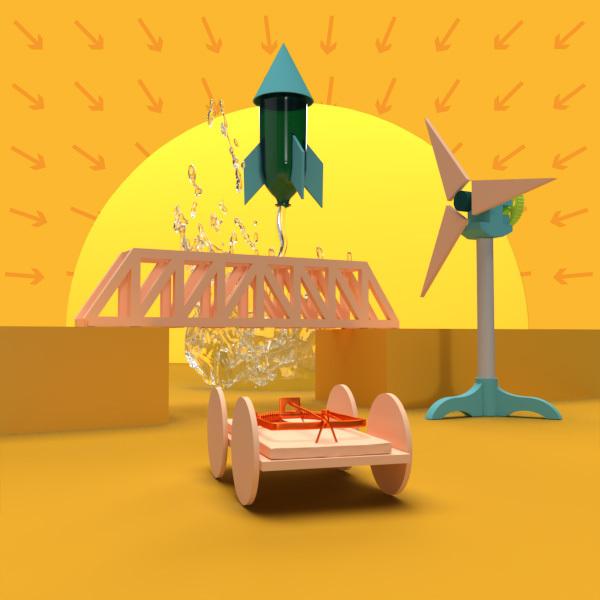
All students benefit when they can apply physics principles and concepts by building something. Having that real-world connection can help make physics easier to understand. As an added bonus, it can also increase student engagement.
During...
Let me begin with a confession: I majored in chemical engineering, not physics. In addition, when I was in college, calculus-based physics and electrical fundamentals courses were used to weed out would-be engineering majors.
Unsurprisingly...