
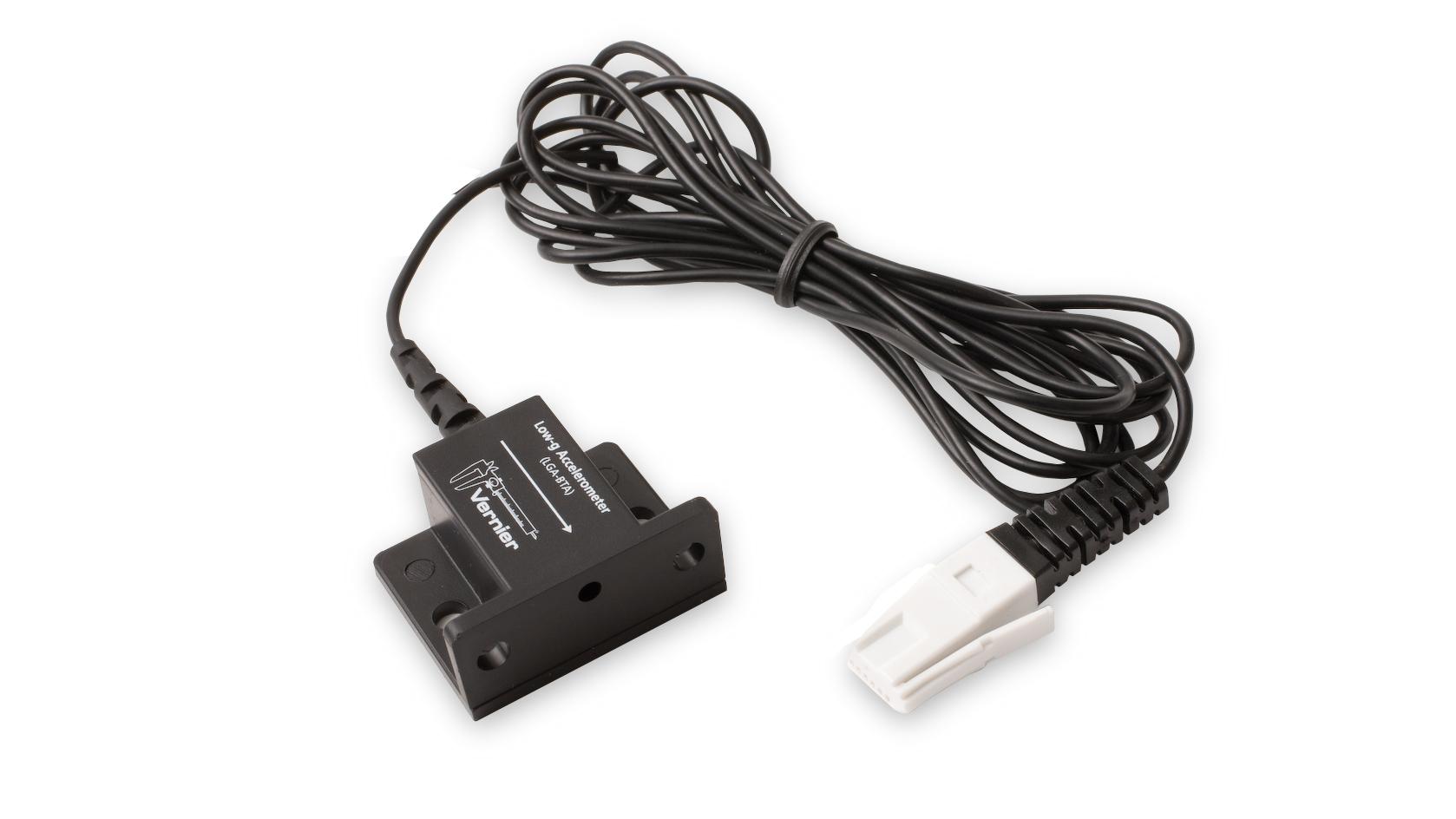
Low-g Accelerometer
Recommended for College and High School. Interface and software sold separately.
Use the Low-g Accelerometer to study one-dimensional acceleration in a wide variety of acceleration experiments and demonstrations.
Description
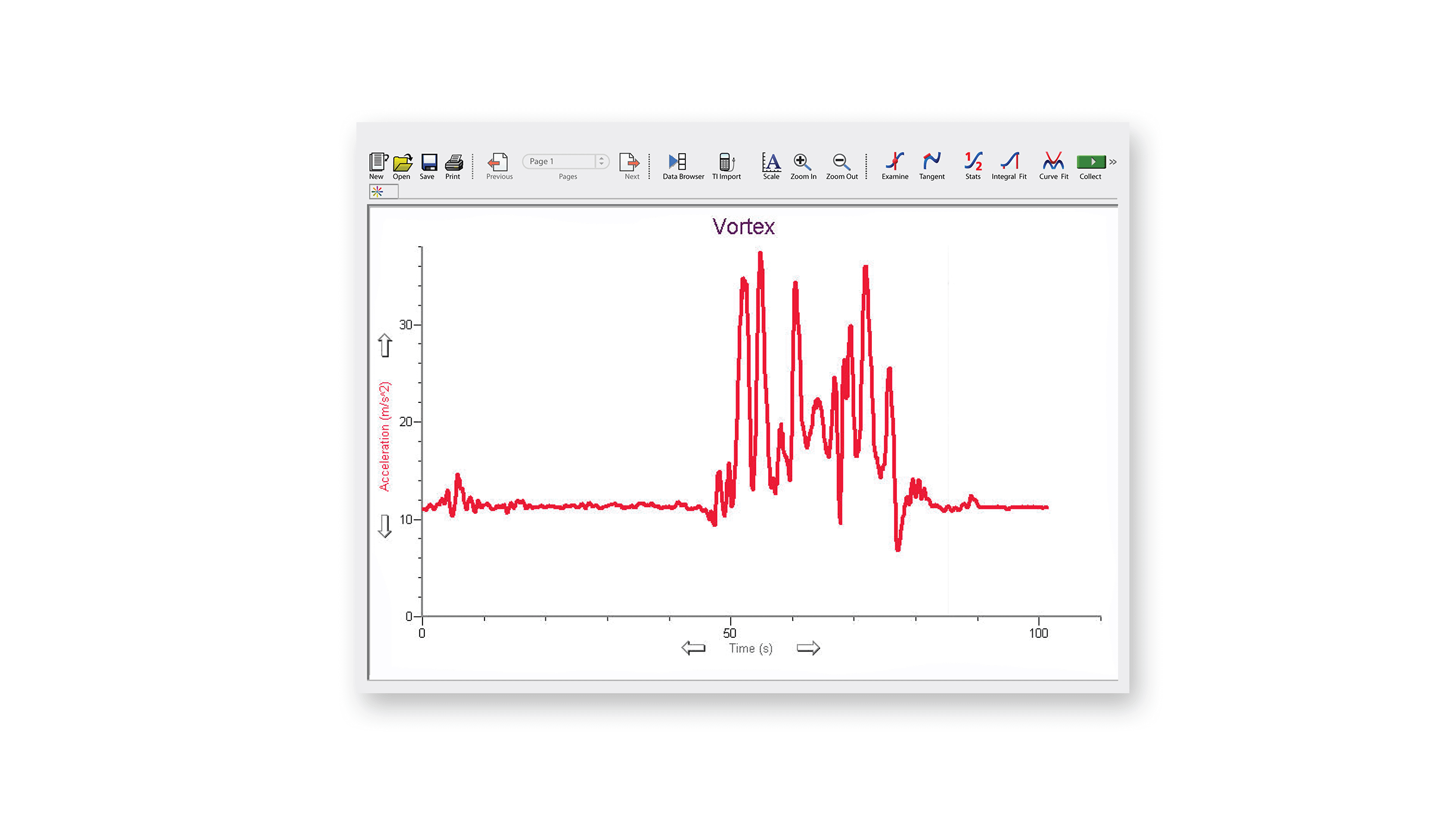
The Low-g Accelerometer is the best choice for most acceleration experiments, including Newton’s second law, simple harmonic motion, and the relationship between acceleration and force. It can also be used to study one-dimensional motion of a car (real and toy), an elevator, a pendulum bob, or an amusement park ride.
Using Multiple Accelerometers
You can simultaneously measure the signals from two or three accelerometers mounted at right angles to measure acceleration in more than one dimension.
- To study acceleration in a plane, mount two accelerometers at a right angle. This is a great way to study accelerations in an automobile.
- Mount three accelerometers at right angles, or better yet use our 3-Axis Accelerometer, to study acceleration in every direction. This is useful for studying the complex motion of an amusement park ride or while bungee jumping.
Specifications
- Power: 30 mA @ 5 VDC
- Range: ±50 m/s² (±5 g)
- Accuracy: ±0.5 m/s² (±0.05 g)
- Frequency Response: 0–100 Hz
- Resolution: 0.037 m/s²
(LabQuest 2, LabQuest, LabQuest Mini, Go!Link, LabPro)
Experiments and Lab Ideas
Select a lab book to see a list of experiments and more information.

Physics with Vernier (4)
Includes student instructions, teacher tips, safety information, and sample data.
Go to Book Page
Science with TI-Nspire Technology (1)
Includes student instructions, teacher tips, safety information, and sample data.
Go to Book Page
Lab Ideas and Innovative Uses
What’s Included
- Vernier Low-g Accelerometer
- User Manual
Sensor Requirements
The Low-g Accelerometer requires a compatible interface and software to collect data. Interface and software sold separately. Getting started with probeware »
Compatible Interfaces
The Low-g Accelerometer is compatible with these interfaces:
Ordering Information
Related Products
Educational use only: Vernier products are designed for educational use. They are not appropriate for industrial, medical, or commercial applications. Product usage disclaimer »
This unit is designed to be used with one of Vernier's interfaces. If you do not plan to use the sensor with a Vernier interface, if you need a stand-alone transducer, or if you do not plan to use the unit in an educational setting, you should check out Analog Devices.

.jpg)


