
Sharing ideas and inspiration for engagement, inclusion, and excellence in STEM
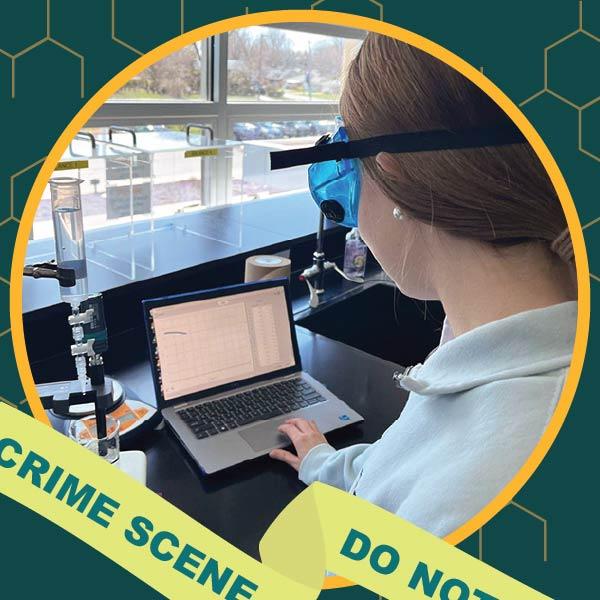
Whether students are fascinated by true crime podcasts, forensic television dramas, or simply enjoy solving a good mystery, forensic science offers a powerful way to connect chemistry concepts to real‑world investigations. During Vernier Science Education’s recent NSTA webinar, educators Anne Lavelle, Randy Booth, and Nüs Hisim shared how forensic case studies can transform traditional chemistry topics into compelling, student-driven investigations.
The appeal goes beyond engagement. Forensic investigations naturally ask students to collect evidence, analyze data, construct explanations, and defend conclusions using scientific reasoning. In other words, they provide a meaningful context for the same chemistry concepts educators are already teaching. As Anne Lavelle noted during the webinar, students aren’t simply completing a lab; they’re “doing science.” And that holds true across course levels—high school chemistry, AP Chemistry, and introductory college courses alike.
If you’re looking for ways to bring more real-world relevance into your chemistry classroom, here are three forensic investigations that combine chemistry content with the excitement of solving a case.
1. Messed Up Makeup: Acid‑Base Titration with a Storyline
Experiment #9A from Forensic Chemistry Experiments
Featured Vernier Technology
In Messed Up Makeup, students investigate a suspicious case involving a stage performer who develops severe chemical burns after using contaminated makeup remover. Their task is to determine how much sodium hydroxide was added to the product and use the evidence to help solve the case.
To crack the mystery, students perform an acid-base titration using a known hydrochloric acid solution and a sample of the contaminated makeup remover. By monitoring pH changes and identifying the equivalence point, they calculate the concentration of sodium hydroxide and determine the total mass added to the original container.
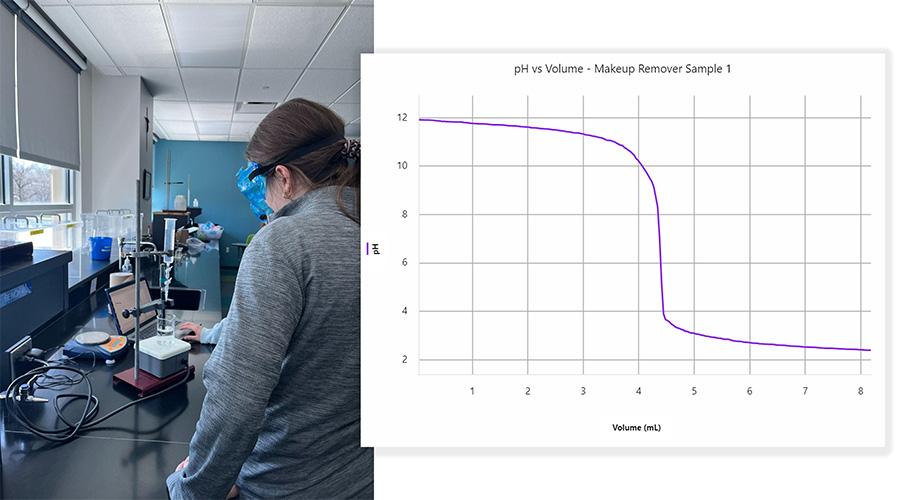
The investigation provides a natural context for concepts that can sometimes feel abstract, including:
- Neutralization reactions
- Dilution calculations
- pH analysis
- Stoichiometry
- Data interpretation
Anne Lavelle, a chemistry teacher at Magnificat High School in Rocky River, Ohio, uses it across her entire course lineup and appreciates how easily it scales. “This investigation is applicable for all levels,” she said. “It applies to everything we usually have to teach, including college prep, honors, AP, and forensics—students are going wild for forensics! We went from three sections the first year we offered it, and now we will offer four sections next year.”
Teacher Tips: Adapting for Class Levels
- College prep: Provide the equations, skip the drop counter, and use the pH probe alone for the titration.
- Honors: Keep most of the lab intact, but remove the derivative analysis—the math isn’t there yet for sophomore students.
- AP: Include the full dilution calculation, the drop counter setup, and the graphical analysis of first and second derivatives. Students recognize the calculus connection and find it satisfying.
Why students love it: They aren’t just finding an endpoint—they’re identifying a suspect and building a scientific case.
2. Burning Accelerants: Calorimetry Meets Crime Scene
Experiment #6 from Forensic Chemistry Experiments
Featured Vernier Technology
Arson investigations often begin with a simple question: What fuel was used to start the fire? In Burning Accelerants, students take on the role of forensic analysts comparing accelerant samples recovered from a crime scene and two suspects.
Using a simple calorimetry setup, they measure the temperature change of water heated by burning fuel samples and calculate the heat of combustion for each accelerant. Students then compare their results to determine which sample matches the evidence.
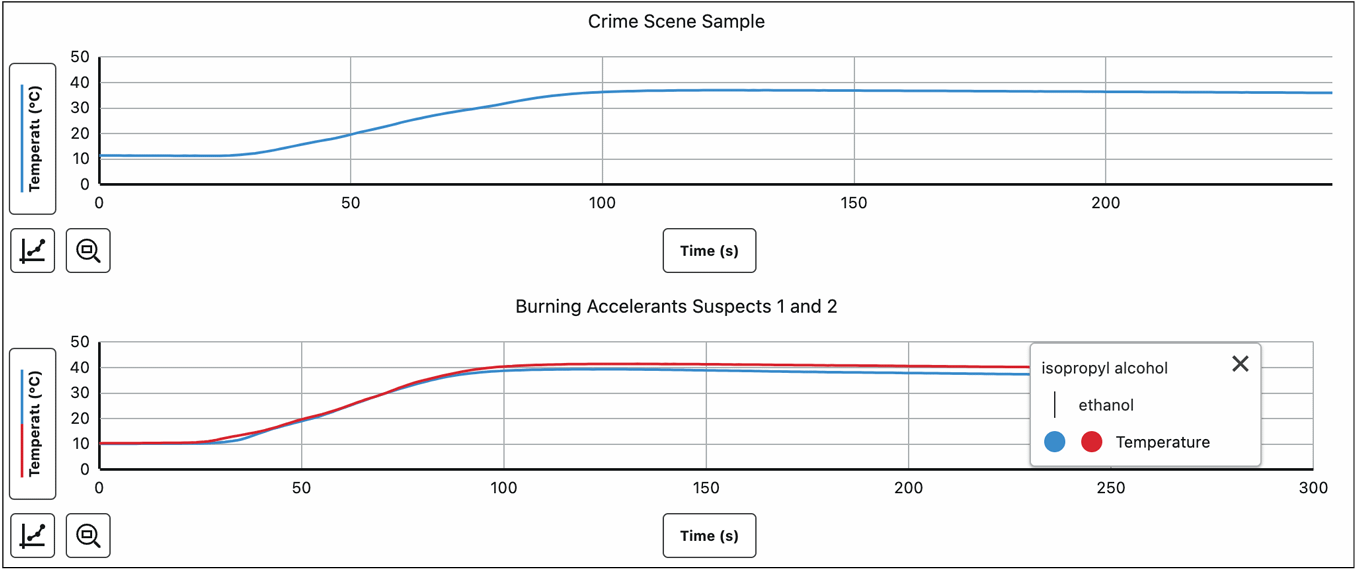
Along the way, they explore important chemistry concepts, including:
- Energy transfer
- Heat of combustion
- Thermochemistry and calorimetry
- Experimental design
- Quantitative analysis
Nüs Hisim, a chemistry specialist at Vernier who helped develop Forensic Chemistry Experiments, highlighted the accessibility of this experiment. “Doesn’t everybody do some kind of calorimetry, q = mCΔT?” He noted. “Everybody does it. But now, turn it into something that’s related to a crime. That’s what makes this experiment compelling.”
Teacher Tips
- Aluminum beverage cans work well; if the tab is missing, punch two small holes near the top to slide a stirring rod through.
- Start with water cooled to 10–15°C for best results, with no ice remaining in the water.
- Alcohol burns with a nearly invisible flame. Make sure students know what to look for before lighting, and always work in a well-ventilated area.
- Extend the math by having students calculate heat of combustion in kJ/mol using molecular weights from the pre-lab.
Why students love it: They use evidence from combustion data to determine which suspect’s fuel matches the crime scene.
3. Arson Analysis: Gas Chromatography and Retention Times
Experiment #15 from Forensic Chemistry Experiments
Featured Vernier Technology
For students ready to experience techniques used in professional forensic laboratories, Arson Analysis: Using Gas Chromatography offers an exciting introduction to instrumental analysis.
In this investigation, students analyze an unknown accelerant recovered from a series of suspicious barn fires. First, they create a library of chromatograms using known compounds. Then they run an unknown sample and compare retention times to identify the components present in the mixture.
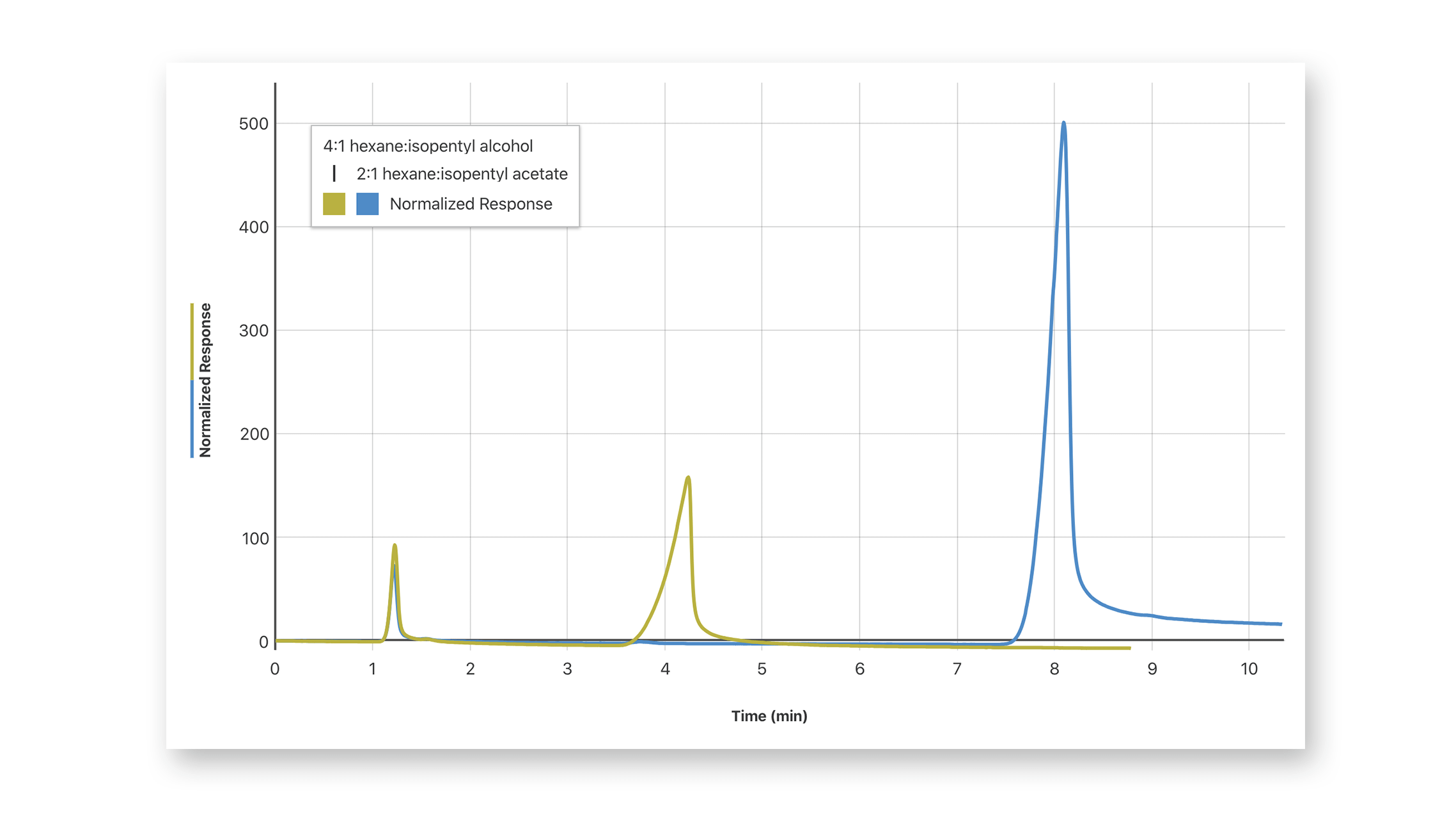
The activity introduces students to abstract concepts, including:
- Gas chromatography
- Retention time analysis
- Intermolecular forces
- Molecular properties
- Separation science
For many students, this is their first exposure to analytical chemistry techniques used by professional forensic scientists, environmental laboratories, and pharmaceutical researchers.
Vernier Trendsetter Randy Booth, who teaches chemistry and physics at Itineris Early College High School in West Jordan, Utah, and as an adjunct at his local community college, uses this lab. “This activity I can use at any level—high school through gen chem at the community college,” he said, adding that watching students work through the investigation has been rewarding. “The GC is a really fun instrument.”
Teacher Tips
- Power the GC for at least 5 minutes before use, and allow it to cool to room temperature before powering off.
- Never pull the syringe plunger back past 0.6 μL—doing so risks pulling the wire out of the needle.
- Use reagent-grade compounds. Water will damage the GC, and store-bought isopropyl alcohol can contain 9–30% water.
Why students love it: They get to use sophisticated instrumentation while solving a realistic forensic mystery.
Explore More Forensic Chemistry Resources
Want to bring forensic science into your own classroom?
Explore these resources:
- Watch: Solve the Case: Bring Forensic Science into Your Chemistry Class
- Watch: Forensic Chemistry: Investigate an Environmental Mystery Using pH Sensors
- Watch: Crime Scene Chemistry: Teaching Reaction Kinetics with a Forensic Twist
- Watch: Chemical Clues: A Titrating Tale of Makeup Remover Contamination
- Explore: Forensic Chemistry Experiments Lab Book
- Explore: Vernier Forensic Chemistry Solutions
Do you have innovative ways of teaching forensic chemistry with Vernier technology? Share with us on social! Questions? Reach out to chemistry@vernier.com, call 888‑837‑6437, or drop us a line in the live chat.
Share this Article
Related Articles






Sign up for our newsletter
Stay in the loop! Beyond Measure delivers monthly updates on the latest news, ideas, and STEM resources from Vernier.