
Sharing ideas and inspiration for engagement, inclusion, and excellence in STEM
Generative AI has changed what students can produce in a matter of seconds. It can generate explanations, summarize scientific concepts, propose experimental procedures, and interpret data. These capabilities create new opportunities for science classrooms, but they also raise an important question: What kinds of learning experiences matter most when information and explanations are so easy to obtain?
That question puts renewed importance on something fundamental to science education: direct experience with the natural world. Students still need opportunities to collect their own evidence, make sense of what they observe, and decide what conclusions are supported by their evidence. In the age of AI, hands‑on science is increasingly important because it gives students firsthand experience with how knowledge is built.
When information is cheap, evidence becomes more valuable.
Science is not simply the acquisition of information. It is a way of building knowledge from evidence. A student who reads an explanation of how temperature affects a chemical reaction has encountered information. A student who changes the temperature of a reaction, measures what happens, and uses evidence to support a scientific explanation is doing something fundamentally different. That student now has a reason to ask: What actually happened? That question anchors scientific thinking in evidence rather than in the authority of a textbook, a teacher, a search engine, or an AI system.
When students generate data themselves, they better understand where evidence comes from. They decide what to measure and how, and they notice when their approach has limitations or when results don’t fit a pattern. Students also learn that they cannot automatically trust their own data. Measurement choices, variability, and potential sources of error are part of determining what the evidence can actually support. These experiences give students something AI cannot provide: firsthand experience with how scientific evidence is produced.
That understanding is not a side benefit. A Framework for K–12 Science Education, which laid the foundation for the NGSS, argues that skill in science practices like these helps students understand how scientific knowledge is produced and become more critical consumers of scientific information. That includes the information students now get from AI.
Real data gives students something to reason about.
Classroom investigations rarely produce perfectly clean results. A temperature reading fluctuates. Two trials produce different values. A graph includes an unexpected point. A sensor detects a change students did not anticipate. Real‑time results may support a prediction, complicate it, or raise a new question. These moments are often when some of the most important learning begins. Students must decide whether an unexpected result reflects natural variation, a flaw in their setup, or a phenomenon they do not yet understand. They may need to repeat trials, revise procedures, compare results with another group, or rethink their explanation. Grounded in evidence, this kind of productive struggle can lead to deeper scientific thinking.
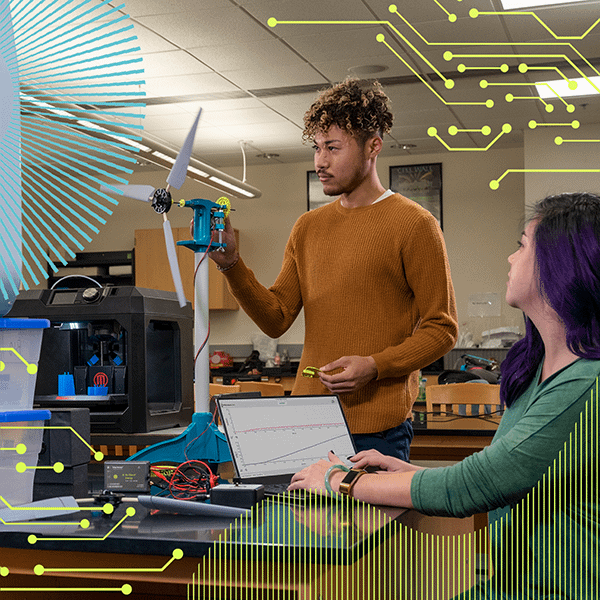
Digital sensors and probeware can make these experiences especially powerful because students can see data develop in real time. Instead of interpreting a finished graph from a textbook, students can connect changes in a physical system directly to changes in the data as they happen. Students can ask why a pattern is emerging, whether the measurements make sense, and what additional evidence might be needed. The technology supports the investigation, but the scientific thinking still belongs to the students.
Hands-on learning helps keep the important thinking with the students.
Putting equipment in students’ hands does not automatically lead to meaningful learning. Students can follow laboratory directions step by step, complete worksheets, and still do very little sensemaking. A hands‑on activity becomes intellectually valuable when students are expected to use what they observe and measure to build and defend explanations. This becomes even more important as AI enters the classroom. If students can ask an AI system to predict results, write a conclusion based on a data table, or generate an entire lab report, educators must think carefully about where the actual learning is happening.
The key question is not simply whether students used AI. It is this: Who did the thinking that the learning goal requires? If the goal is to analyze evidence, then students must analyze evidence. If the goal is to construct explanations, students must wrestle with how their evidence connects to those explanations. If the goal is to evaluate data quality, students need experience noticing variation, uncertainty, and limitations.
AI becomes more useful when students have their own evidence.
Hands-on investigation and AI do not need to compete. Some educators are already designing AI prompts that ask students questions instead of providing answers, helping them turn early observations of a phenomenon into questions they can investigate. Firsthand evidence from hands‑on investigations can also make the use of AI more meaningful for students. Imagine students investigating how light intensity changes with distance from a source. They collect measurements using a sensor and examine the resulting pattern. After working with their own data, students ask an AI system to interpret the results. Now they have something to compare against. Does the AI notice the same pattern they observed? Does its explanation match the data? Does it ignore an outlier? Does it make claims the evidence cannot support? What would they revise or challenge?
The AI response becomes something to analyze and evaluate rather than something to accept as authority. Instead of outsourcing sensemaking, students use AI within a process where observation, evidence, disciplinary knowledge, and human judgment remain central.
Protecting the experiences science makes possible.
Generative AI is already prompting educators to rethink familiar classroom practices. Some assignments may need to change because final products no longer reveal enough about the thinking that produced them. Hands‑on science offers something different. Students can observe phenomena that do not behave exactly as expected. They can watch graphs form from their own measurements. They can debate why different groups obtained different results. They can revise explanations when evidence does not support their initial ideas. These experiences help students learn not only scientific concepts, but the practices through which scientific knowledge is built. As AI becomes increasingly capable of producing information, explanations, and polished outputs, science education has an opportunity to place even greater value on what students can observe, measure, question, and reason through themselves.
The future of science education does not require choosing between powerful technology and hands‑on learning. It requires being intentional about the role each plays. AI can help students access information and explore ideas. Digital tools can expand what students can measure and visualize. But students still need opportunities to engage directly with the world, generate evidence, and decide what conclusion that evidence supports. Scientific judgment develops when students have repeated opportunities to make those decisions. As AI gets better at producing answers and explanations, these opportunities become even more valuable, not less.

Led by Executive Director Chris Lazzaro and Operations Director Velma Itamura, the Science & Technology Advancement Center (STAC) is a nonprofit organization that works with states, districts, and companies to design, develop, and implement high‑quality science programs. We focus on integrating new and emerging technologies into classroom settings to support 3‑dimensional learning.
Share this Article
Related Articles


Sign up for our newsletter
Stay in the loop! Beyond Measure delivers monthly updates on the latest news, ideas, and STEM resources from Vernier.