
Sharing ideas and inspiration for engagement, inclusion, and excellence in STEM
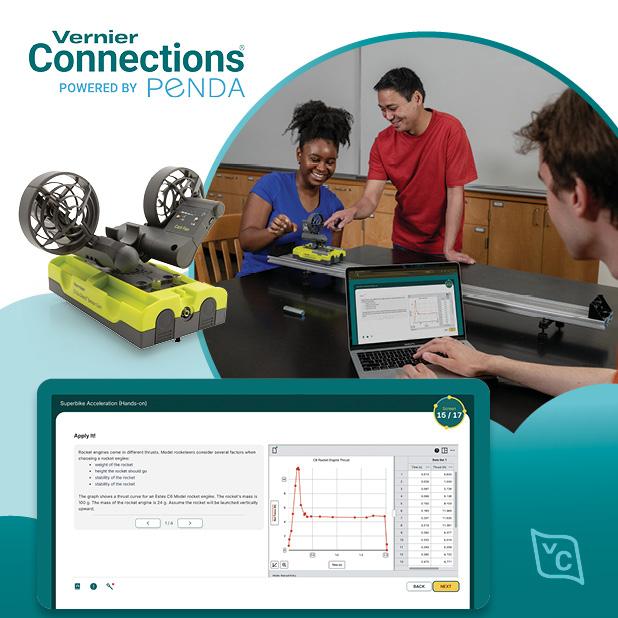
Three-dimensional learning is at the heart of the Next Generation Science Standards—but knowing the framework and implementing it consistently are two very different challenges. Vernier Connections® is designed to help bridge that gap. Handcrafted to the NGSS and aligned to state standards, Connections lessons, activities, and assessments blend the strengths of digital and hands-on learning. This flexible approach deepens student engagement and supports teachers in delivering consistent, accessible, and phenomena-based science instruction in every classroom. In this post, we’ll unpack the three dimensions of learning and walk through an example of a hands-on Connections investigation to show how all three come to life in practice.
What Is Three-Dimensional Learning?
The goal of three-dimensional learning is for students to learn science by doing science. It acknowledges that science is not merely a body of knowledge reflecting our current understanding of the world and that domain mastery isn’t about memorizing facts. Instead, three-dimensional learning aims to actively engage students in scientific and engineering practices and the application of crosscutting concepts to deepen their understanding of core scientific ideas.
Knowledge of scientific practices, crosscutting concepts, and the core ideas of science and engineering make up the three pillars of the NGSS. Mastering these pillars enables students to become critical consumers of scientific information, engage in evidence-based discourse on science-related issues, and continue to learn about science throughout their lives.
A Closer Look at the Three Dimensions
Science and Engineering Practices
Science and Engineering Practices (“SEPs”) are the cognitive skills scientists use to develop knowledge across domains. As students build experience with these practices, they understand how scientific knowledge is acquired—and become builders of knowledge themselves, rather than just recipients.
Crosscutting Concepts
Crosscutting Concepts (“CCCs”) are thinking tools that apply across all science disciplines—patterns, cause and effect, systems and models, and scale. They guide scientific work because they are the tools students use to figure out answers to scientific questions and deepen their understanding of the world around them.
Disciplinary Core Ideas
Disciplinary Core Ideas (“DCIs”) are the big ideas with the most explanatory power, intentionally reduced in number from previous standards. Rather than memorizing disconnected facts, students develop foundational understanding they can apply across contexts and use to keep learning on their own.
How Three-Dimensional Learning Shapes Connections Lessons
The shift to three-dimensional learning has been a significant one for educators. Most teachers didn’t learn science this way, haven’t always addressed standards this way, and—perhaps most importantly—haven’t always had access to high-quality resources that make this approach feel manageable. Connections is designed to change that.
Every Connections lesson is built to be ready to teach from the moment a teacher opens the platform—no extensive prep, no extra mapping, no starting from scratch. Whether they’re a veteran teacher looking to strengthen their 3D practice, a new teacher still finding their footing, or a substitute teacher keeping instruction moving, Connections provides the structure and support to deliver three-dimensional science with confidence.
Connections lessons are built backward from the learning goal, with anchoring phenomena carefully selected to represent targeted disciplinary core ideas, one to two crosscutting concepts woven throughout, and hands-on investigations that build proficiency with the SEPs. Within each lesson, students move through a variety of instructional stages led by action verbs—observing phenomena, planning and carrying out investigations, modeling, analyzing, and applying their understanding to new contexts.
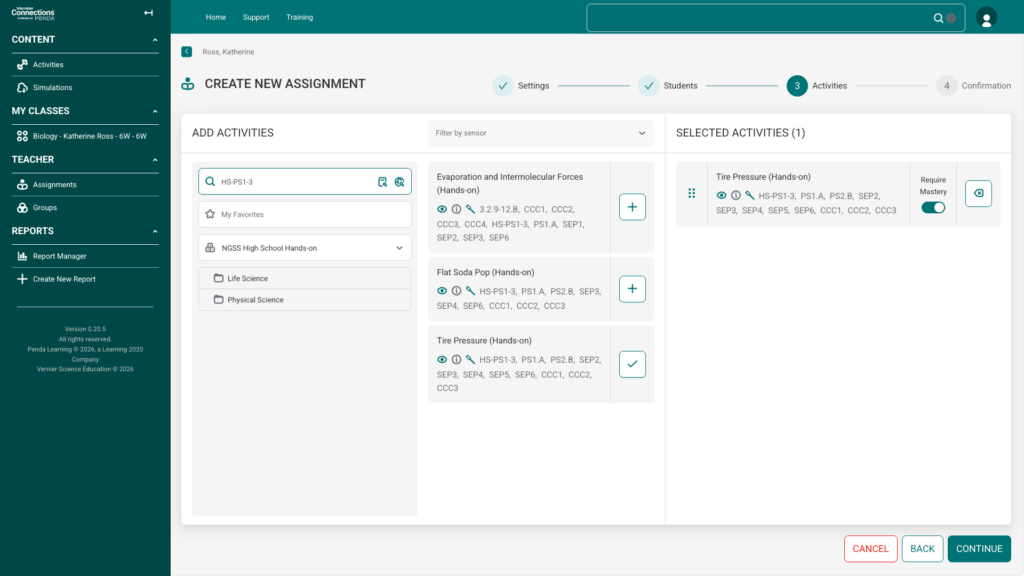
Teachers can search for the right lesson not just by topic, subject, grade level, and sensor compatibility, but also by DCI, CCC, SEP, and Performance Expectation.
Connections Lesson: Tire Pressure
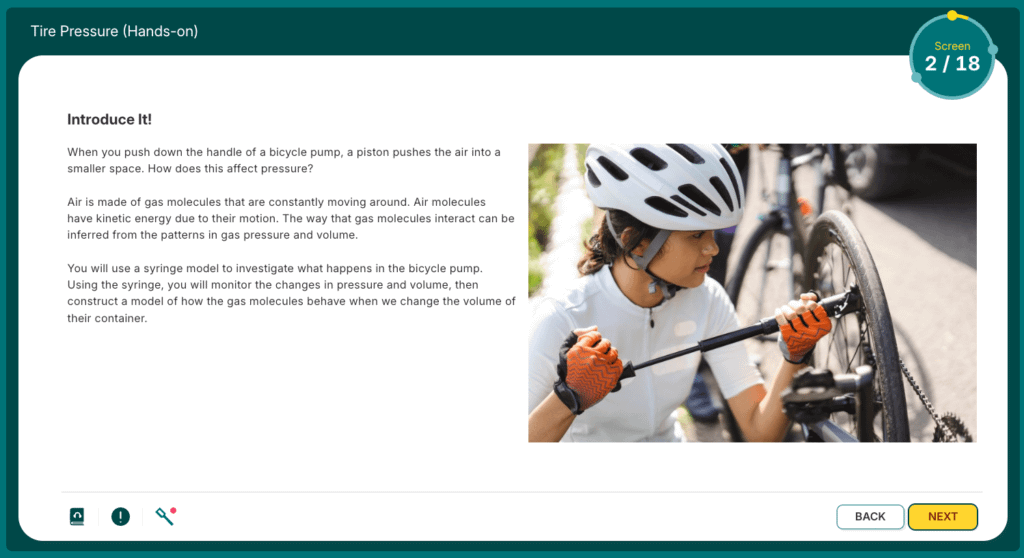
Let’s look at a specific example: the Connections “Tire Pressure” lesson, which explores gas pressure and volume. The lesson begins with a concrete, relatable phenomenon—pushing down a bicycle pump—and is anchored to the Performance Expectation: “Plan and conduct an investigation to gather evidence to compare the structure of substances at the bulk scale to infer the strength of electrical forces between particles.” Students aren’t just measuring pressure and volume—they’re using what they can observe to draw conclusions about what they cannot see. The following sections show how all three dimensions work together to get them there.
Science and Engineering Practice: Developing and using models
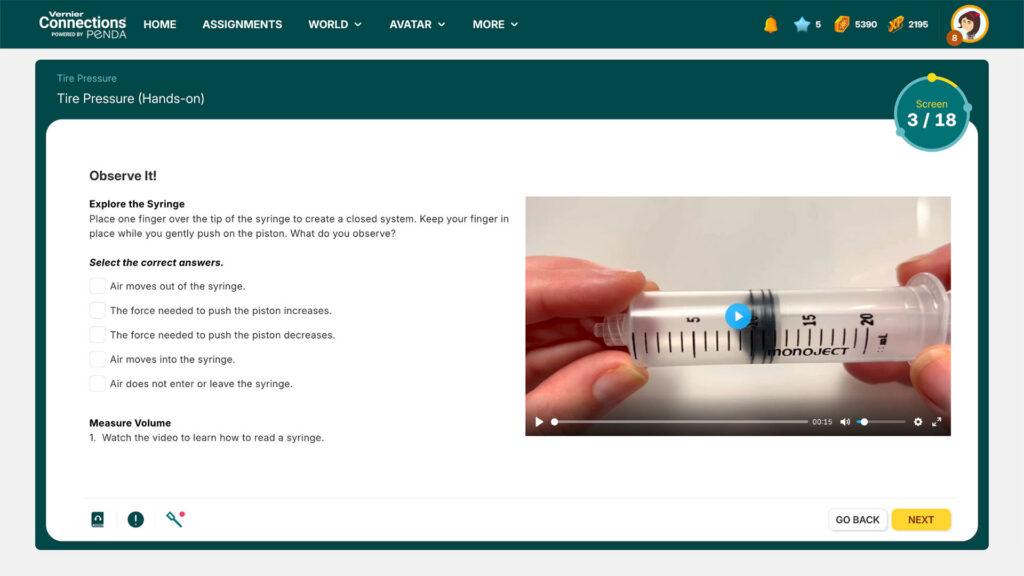
Modeling in this lesson begins before students touch a sensor. In the Observe It! stage, students get hands-on with a syringe—placing a finger over the tip to create a closed system and pushing the piston to feel what happens. A short video is also available for reference. Together, these experiences establish the key constraints of the system students will be modeling: Air does not enter or leave, and the force required to push the piston increases.
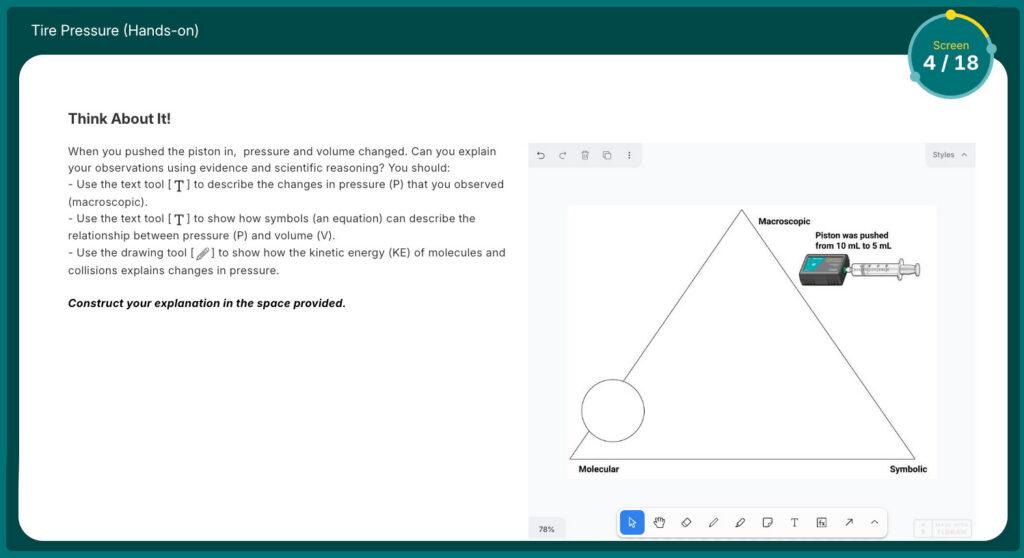
Next, students construct an initial model using a three-representation scaffold—describing the macroscopic pressure change in words, representing it symbolically in an equation, and drawing what they think is happening at the molecular level—before they’ve collected any data. At the end of the lesson, students return to the same scaffold and complete it using everything they’ve learned. The bookend structure makes the growth in student thinking visible to both students and teachers.
Science and Engineering Practice: Planning and carrying out investigations
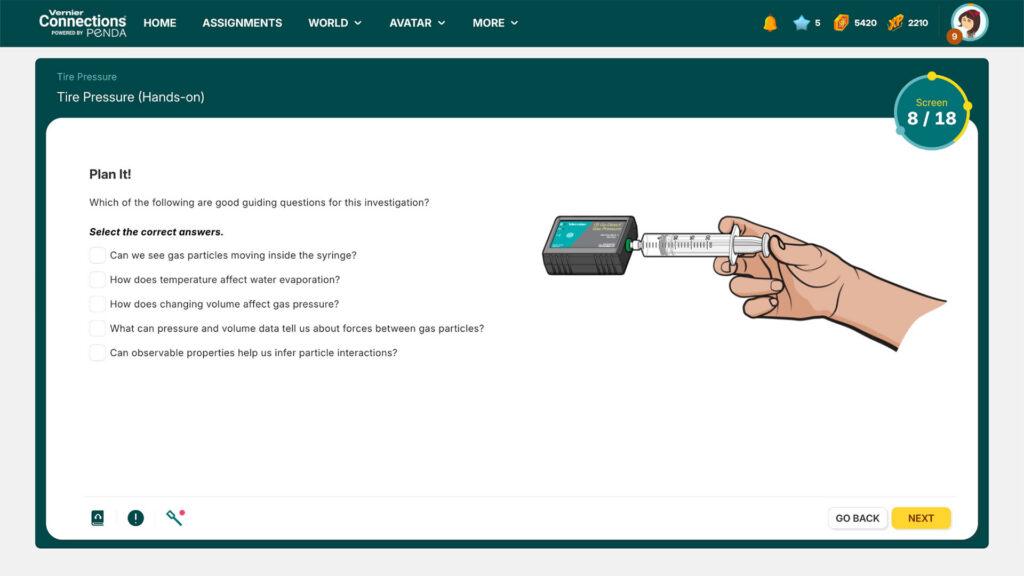
The Plan It! stage walks students through experimental design as an active thinking task. Students evaluate appropriate tools, identify variables to control, and select productive guiding questions—such as “What can pressure and volume data tell us about forces between gas particles?” and “Can observable properties help us infer particle interactions?”—so the investigation has a clear purpose from the start.
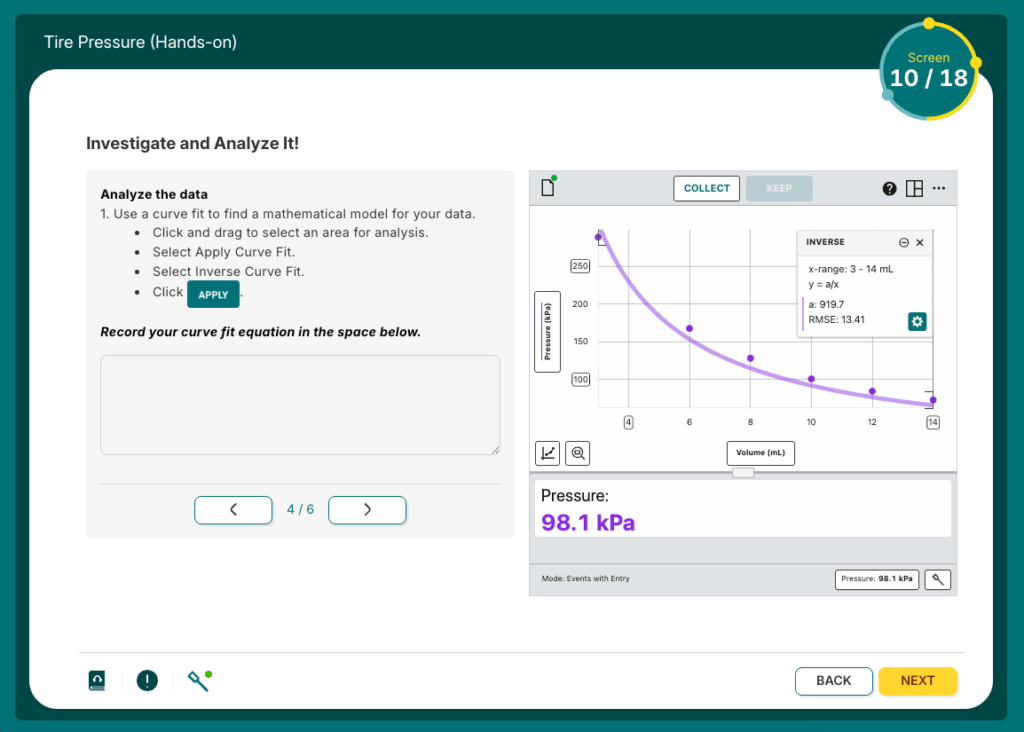
In the Investigate and Analyze It! stage, students use the Go Direct® Gas Pressure Sensor to collect pressure readings across a range of volumes. Vernier Graphical Analysis® software is built into the Connections platform, allowing students to easily collect and analyze live data from their investigation using graphing, interpolation, and inverse curve fitting to identify the mathematical relationship.
Crosscutting Concept: Patterns
At the high school level, the NGSS asks students to recognize that patterns observed at one scale can provide evidence for causality at another. In the Analyze It! stage, students use the macroscopic pattern in their data—pressure and volume follow a precise inverse relationship—as evidence to draw causal conclusions about particle-level behavior. What does it mean that gas behaves so predictably when compressed? The predictable relationship suggests particles are moving independently and that electrical forces between them are weak. The pattern isn’t the endpoint; it’s the evidence that drives the explanation.
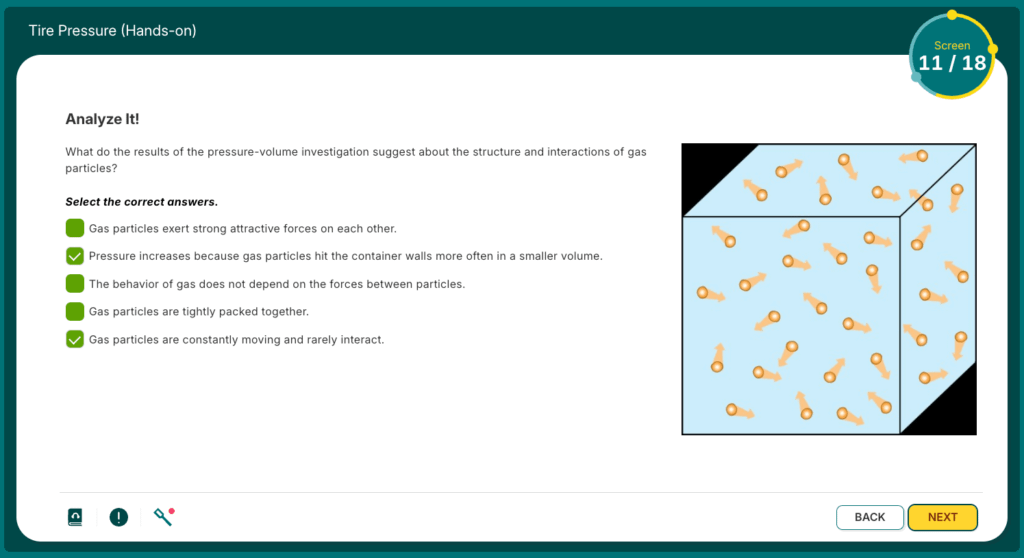
Disciplinary Core Idea: Structure and properties of matter
Kinetic molecular theory and the ideal gas law are introduced after students have already collected evidence and begun reasoning toward these ideas—placing formal explanation where it belongs, in service of understanding students have started building themselves.
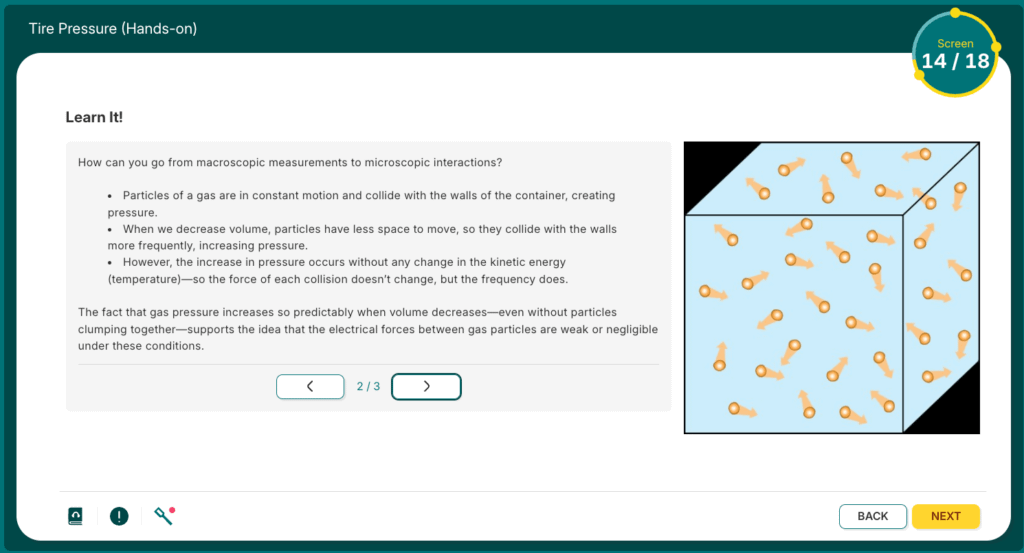
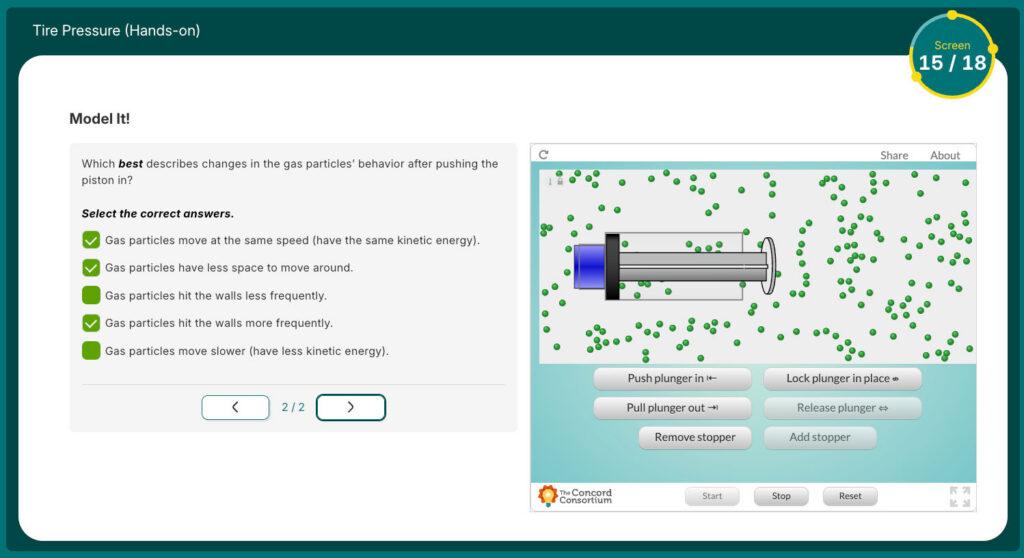
An interactive simulation lets students observe air molecules directly, manipulating the syringe plunger and watching particles respond in real time, reinforcing the connection between the macroscopic pattern they measured and the particle-level behavior that explains it.
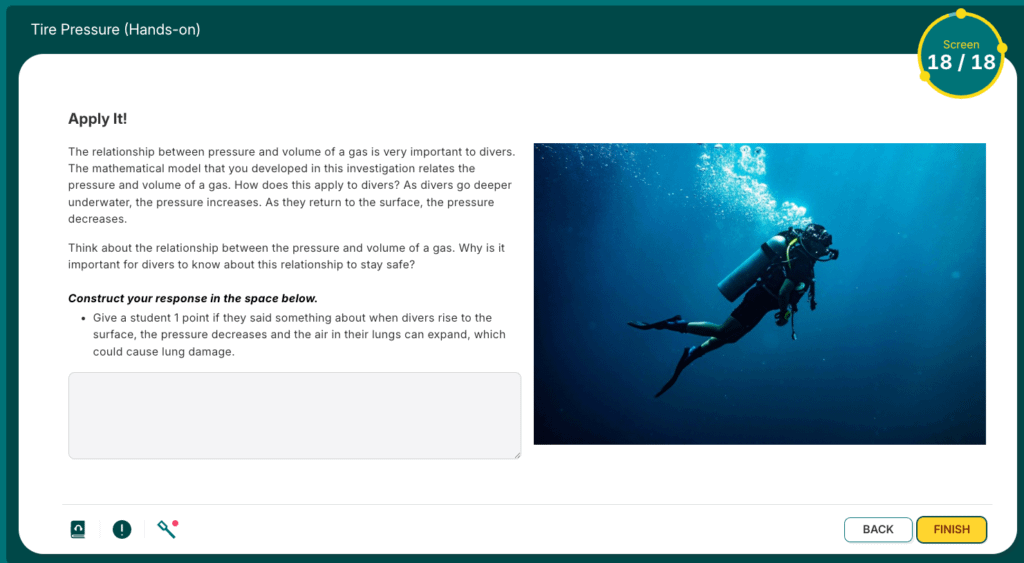
In the Apply It! stage, students transfer their understanding to a real-world context: scuba diving. As a diver rises to the surface, pressure decreases and the gas in their lungs expands. Students explain why that relationship matters for diver safety—applying both the mathematical model and the particle-level reasoning they‘ve developed throughout the lesson.
Three-Dimensional Science, Ready to Teach
The “Tire Pressure” lesson shows what’s possible when three-dimensional design is built into every stage of the learning experience. Students move from an anchoring phenomenon to an initial model, through experimental design, hands-on data collection, pattern analysis, evidence-based reasoning, interactive simulation, and real-world application. That’s the full sensemaking cycle—and it leads somewhere specific: Students who can use evidence they collected themselves to make a scientifically grounded inference about the invisible world of particles.
And because all of that structure lives inside the platform—with instructional guides, built-in scoring, reading supports, and formative assessment embedded throughout—teachers spend less time lesson planning and more time doing what they do best: facilitating real learning.
Vernier Connections is designed to support teachers in meeting the rigorous demands of today’s science standards—and to nurture every student’s development as a science-literate, curious thinker. Whatever your experience level, the structure is there. The science is there. And students get to do the discovering.
Explore how Connections can help solve science instruction challenges in your school or district.
Share this Article
Related Articles




Sign up for our newsletter
Stay in the loop! Beyond Measure delivers monthly updates on the latest news, ideas, and STEM resources from Vernier.