
Sharing ideas and inspiration for engagement, inclusion, and excellence in STEM
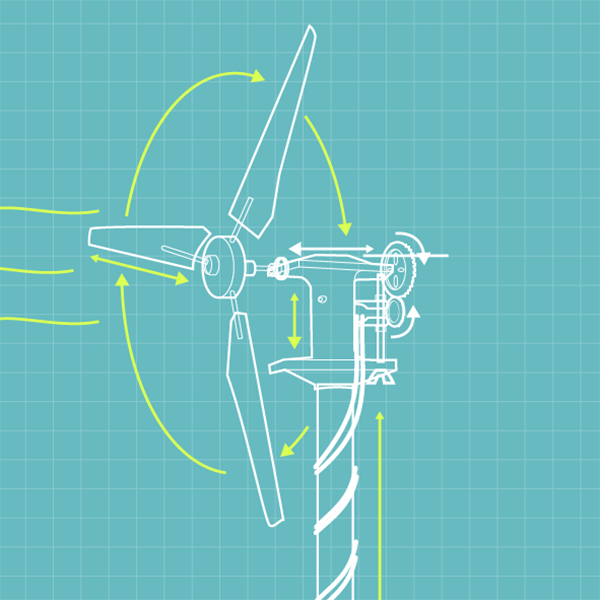
What if your students could build a wind turbine, optimize it through real investigation, and use it to pump water uphill—all while covering circuits, electromagnetism, energy transfer, and engineering design in one connected renewable energy project?
That’s exactly what Chris Williams, a science teacher at Maimonides School in Boston, Massachusetts, has built. A 30-year teaching veteran and Vernier Trendsetter, Chris is always asking how to make the physics more meaningful and the engineering more relevant. The result is a multi-phase project built around the KidWind Advanced Wind Experiment Kit, the Go Direct® Energy Sensor, and the Vernier Variable Load that takes students from circuit basics all the way to a wind‑powered water pumping competition—rigorous enough for AP and introductory college physics, applied enough for a CTE energy pathway, and adaptable enough to fit a high school STEM elective or a standalone unit. And like any good engineering project, it keeps getting better every time he runs it.
Renewable Energy Growth Is Happening Right Now
Wind and solar are now the cheapest forms of new electricity generation being built in the United States—and according to the U.S. Energy Information Administration, solar and wind together account for 65% of new utility‑scale capacity planned for 2026. Globally, China alone is adding enough solar and wind power each year to cover the total electricity use of entire countries.
Closer to home for Chris, Vineyard Wind 1—the first major offshore wind project in Massachusetts—has recently completed construction off the coast of Martha’s Vineyard and begun delivering electricity to the grid. When fully operational, it will power nearly 400,000 homes and businesses across the state. This isn’t a hypothetical engineering challenge. It’s the energy landscape students are inheriting—and for many, it’s the industry they may enter. Wind turbine technician is one of the fastest-growing occupations in the United States, and the skills this project develops (reading electrical data, iterating on a design, understanding system trade-offs) are directly transferable to energy technology careers.
A Multi-Phase Project Structured Around Systems Thinking
Chris structured his project around systems thinking—each phase adding one more link in a chain that runs from wind in the air to water pumped uphill:
- Wind
- Blades
- Shaft & Gears
- Generator
- Rectifier
- Load & Pump
Each phase builds student understanding alongside the physical turbine itself. The whole sequence runs about six to seven weeks in a STEM elective that meets three times a week—though individual phases can be lifted and adapted for use in a physics unit, a CTE course, or an intro college lab.
Phase 0: Start with the Science, Not the Build
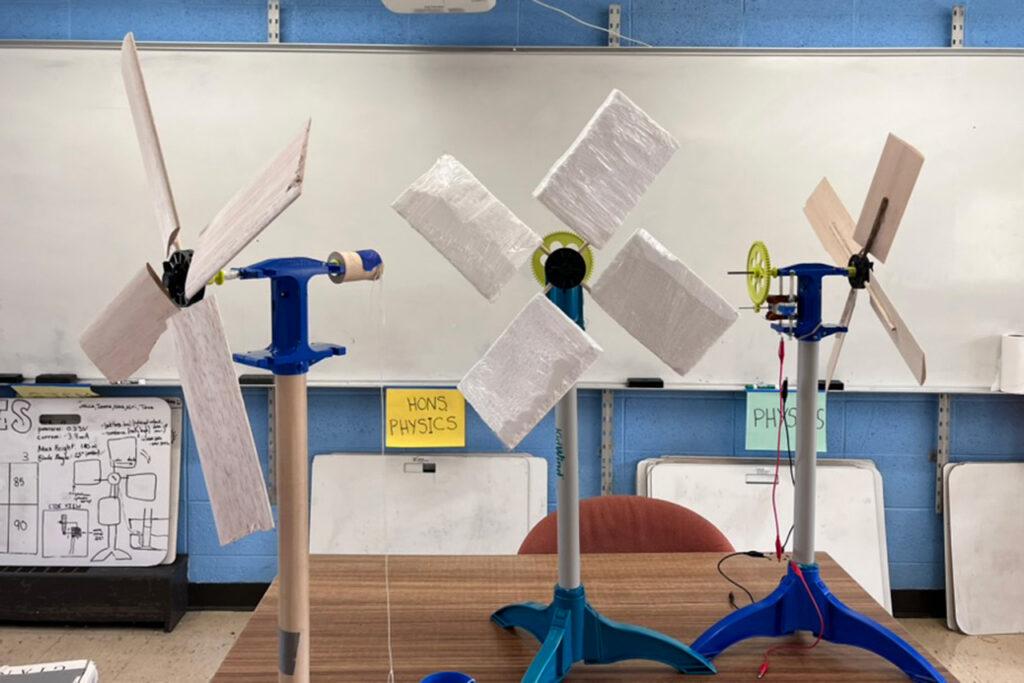
Before students touch a single blade, they spend time with circuits. Using the Go Direct Energy Sensor, they explore voltage, current, resistance, and power—measuring potential differences, observing how a compass needle deflects near a current-carrying wire, and building the quantitative intuition they’ll need later when their generator isn’t behaving the way they expect.
It’s foundational work, but Chris frames it with purpose: You need to understand these quantities now, because you’ll be designing around them in every phase that follows.
Phase 1: Wind Becomes Mechanical Power
Now, students build. Using the KidWind Advanced Wind Experiment Kit, each team constructs a three-blade turbine and tests blade pitch angles from 10° to 50°, measuring how fast they can lift a weighted bucket at each setting. Students calculate power, and teams iterate toward their best angle before locking it in.
This phase introduces torque and mechanical power in a way that’s immediately legible: The turbine either lifts the mass or it doesn’t. The physics isn’t abstract. It’s the difference between a bucket on the floor and a bucket in the air.
Phases 2A and 2B: Build a Generator, Then Add Gears
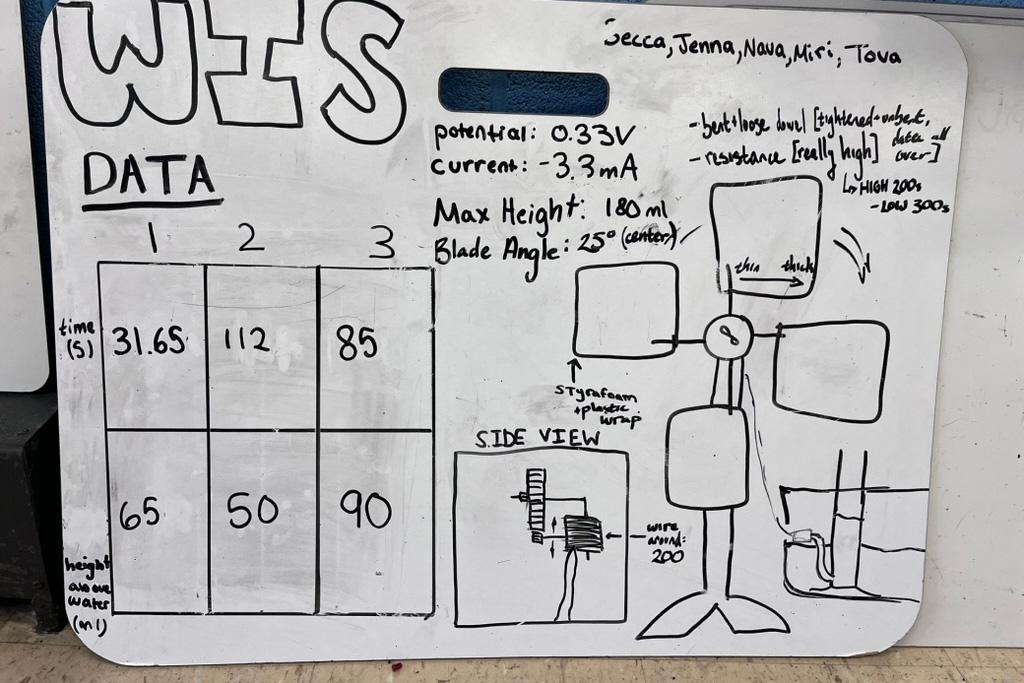
This is where things get genuinely hands-on in a way students don’t expect from a physics class. Each team winds their own electromagnetic generator coil—somewhere between 150 and 300 turns of 28-gauge magnet wire—and installs it on their turbine. The class then pools data across groups with different winding counts, giving everyone a real dataset to test Faraday’s law: more turns of wire means more induced voltage.
Phase 2B adds gears to the drivetrain. Students quickly learn that a larger gear ratio spins the generator faster—but it also demands more torque from the blades. Push the ratio too high and the turbine stalls. It’s a lesson in trade-offs that no worksheet can replicate.
Phase 3: Matching Load to Generator
Using the Go Direct Energy Sensor and a Vernier Variable Load, students sweep through a range of resistance values and measure the power output of their generator at each setting. The result is a curve with a clear peak—the resistance value at which maximum power is delivered to the load. That peak corresponds to the generator’s internal resistance, a concept pulled directly from the physics of real electrical systems.
The payoff comes when students connect their turbine to a water pump and discover that a fast‑spinning turbine generating high voltage can still fail to pump a single drop of water—because the current is too low.
That moment of confusion leads to one of Chris’s favorite classroom conversations: What do voltage and current actually mean, and why do you need both?
Phases 4 and 5: Optimize the Blades, Then Compete
With the electrical system characterized, students return to the blades—this time optimizing for electrical power output rather than mechanical power alone. They test variables like blade number, length, shape, and material, collecting data at each step and building toward a final configuration they can defend with evidence.
The culminating challenge is straightforward and genuinely clarifying: Pump as much water as high as possible in 30 to 60 seconds. The AC output of the generator passes through a rectifier circuit (which students build themselves by the end of the project), powers the water pump, and the competition begins. Every design decision made across the previous phases either pays off or doesn’t.
Chris hasn’t yet fully explored one extension question with his students: If you connected the class’s turbines together into a small wind farm, should they be wired in series or parallel to maximize pumping power? By Phase 5, students have everything they need to work that out.
Meaningful Engagement Across Physics Standards and Engineering Practices
The scope of physics covered across this project is substantial—mechanical work and power, torque, electromagnetic induction, Faraday’s and Lenz’s laws, AC versus DC, internal resistance, maximum power transfer, rectification, and circuit design. All eight NGSS Science and Engineering Practices are addressed across the phases, along with multiple HS-PS2, HS-PS3, and HS-ETS1 performance expectations.
But what Chris found most valuable wasn’t the content coverage—it was the conceptual depth students developed because they needed it to solve a real problem.
When a student’s turbine is spinning fast and the water isn’t moving, they’re motivated to understand why in a way that a textbook problem never quite achieves.
Chris ran this project primarily with 11th and 12th graders, though a handful of 9th and 10th graders participated successfully with peer support. He notes that grading should focus on demonstrated understanding of the science rather than construction quality—many of his students had never used a screwdriver before this project, let alone wound a coil of magnet wire.
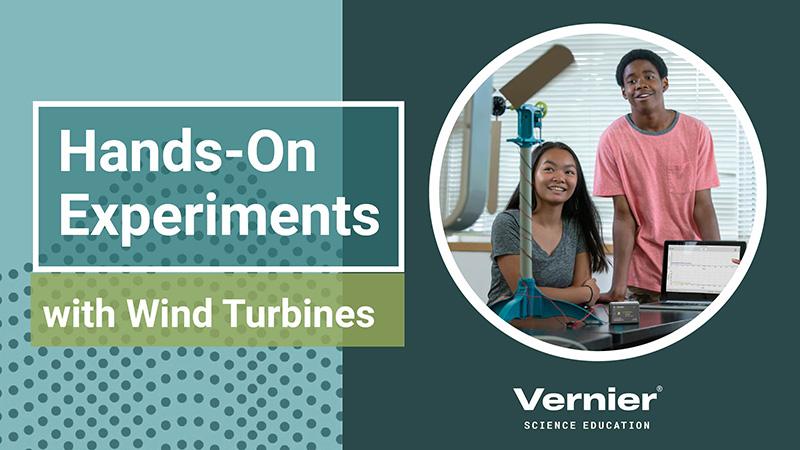
Ready to try it yourself? Start with the webinar recording to hear Chris walk through the full project, and explore free resources shared in the webinar.
You can also start with our lab book, Renewable Energy with Vernier.
Are you using KidWind or renewable energy projects in your classroom? We’d love to hear about it—reach out at kidwind@vernier.com or share your work with us on social.

Chris Williams has been teaching science for 30 years. He is currently a science teacher at Maimonides School in Boston, Massachusetts, and a member of the Vernier Trendsetters Community. He has participated in two Arctic expeditions focused on energy and environmental education and is passionate about connecting physics instruction to real-world engineering challenges.
Share this Article
Related Articles

Sign up for our newsletter
Stay in the loop! Beyond Measure delivers monthly updates on the latest news, ideas, and STEM resources from Vernier.